This is the first one:
Showing posts with label touch russia. Show all posts
Showing posts with label touch russia. Show all posts
Covid-19 chronicles: how local businesses survived
The owners of several St.Pete's bars were filming simple documentary series in the heat of April 2020. There are subtitles in English, all the series are on YouTube.
This is the first one:
This is the first one:

How do the Russians laugh online?
Like the Greeks do:

Because we have cyrillic alphabet, obviously. Ха-ха-ха.
Compare with 555, jajaja and others here:
How People Express Laughter in Different Languages Around the World
Because we have cyrillic alphabet, obviously. Ха-ха-ха.
Compare with 555, jajaja and others here:
How People Express Laughter in Different Languages Around the World
Instagram of regular Russia
I personally enjoy Instagram from 2010. So it's been already longer than 5 years of me watching how the life goes in many corners of this planet.
I have Spanish friends, Japanese friends, American friends, Australian ones and so forth. I can see the world with their eyes.
Let me show you one of Russian instagramers. He doesn't live in Moscow or Petersburg. He lives in Russia. The city name is Tomsk.
I have Spanish friends, Japanese friends, American friends, Australian ones and so forth. I can see the world with their eyes.
Let me show you one of Russian instagramers. He doesn't live in Moscow or Petersburg. He lives in Russia. The city name is Tomsk.
Working in Russia: Finnish investor shares his impressions
If you’re working in international business, you have most likely participated in some kind of diversity or cultural training sessions. You know the kind. Those meetings where we learn that Germans are punctual, Italians are emotional and Finns don’t talk — without some alcohol.
For me, the past 1,000 days of working in Russia have been a true deep dive into the Russian landscape, business culture and mentality. And I have gained an understanding that is impossible to get from these sterilized meetings, which tend to focus on stereotypes.
During this amazing journey, I have visited 59 Russian cities, embraced numerous governors and seen all 11 time zones of this enormous country. And it is worth mentioning that all my preconceived notions about Russia were wrong.
Before deciding to come to work in Russia, I had very little knowledge of it, even though my own country — Finland — shares a long border with it. I had been a tourist in Moscow and St. Petersburg, but as the Finnish and Russian languages share probably only three common words, my ability to communicate and get to know people was very limited.
So what are my observations so far?
I’m a nerd, so I was thrilled to see the level and quality of telecommunications across the country — in complete contrast to my wildest expectations. Russians truly love and use all the latest gadgets. The post-Soviet “PlayStation Generation” is particularly well connected. Social media is widely used, and news from all over the world is at everyone’s fingertips. There is no “Great Firewall,” on the Russian Internet, like in China, so it is very annoying to see even serious, informed people lump Russia and China together in the same category when discussing online freedom.
Despite all my doubts, the infrastructure of the cities I have visited more or less meets European and American standards. Yes, some of the roads are pretty bad, but airports, hotels, restaurants and other services are well developed. Starbucks is everywhere, and I use my credit card for almost everything. I pay my bills using the online services of Russian banks, and money transfers from my home bank can be arranged overnight. For travel I use mostly airlines like Aeroflot, which has a very modern fleet of Airbus planes. I am not a specialist in air travel by any means, but as an anecdote I must say that in the past 1,000 days, I have only had my flights delayed twice, and for 15 minutes at the most.
Of course the state of the Russian economy right now is not good, but this current turbulence is good for my business — promoting the culture of startups and innovation in Russia. If oil prices were high, it would be practically impossible to convince any local businesses to make difficult restructuring decisions.
Naturally, I don’t wish hard times on anyone, but now, when I see the creation of new businesses and the modernization of big companies, I can’t help but think that there are some benefits to the current situation.
Also from the standpoint of an investor, the devalued currency has created many opportunities — after all, our potential to make money occurs in the “buying” stage of the investment.
But I must mention the most beautiful part of life in Russia — the food. When I arrived in the country, the only Russian food I knew of was borscht. But in the first few days, I realized that Russians will spend a lot of money on two things — high-quality food and high-heeled shoes. In every city I visit, I just have to log on to TripAdvisor to see an amazing variety of restaurants and cuisine.
There is something for every taste — from sushi to Caucasian cuisine.
So, dear friends in the global business community, open your eyes to Russia. Take it from me — seeing is believing!
Source
For me, the past 1,000 days of working in Russia have been a true deep dive into the Russian landscape, business culture and mentality. And I have gained an understanding that is impossible to get from these sterilized meetings, which tend to focus on stereotypes.
During this amazing journey, I have visited 59 Russian cities, embraced numerous governors and seen all 11 time zones of this enormous country. And it is worth mentioning that all my preconceived notions about Russia were wrong.
Before deciding to come to work in Russia, I had very little knowledge of it, even though my own country — Finland — shares a long border with it. I had been a tourist in Moscow and St. Petersburg, but as the Finnish and Russian languages share probably only three common words, my ability to communicate and get to know people was very limited.
So what are my observations so far?
I’m a nerd, so I was thrilled to see the level and quality of telecommunications across the country — in complete contrast to my wildest expectations. Russians truly love and use all the latest gadgets. The post-Soviet “PlayStation Generation” is particularly well connected. Social media is widely used, and news from all over the world is at everyone’s fingertips. There is no “Great Firewall,” on the Russian Internet, like in China, so it is very annoying to see even serious, informed people lump Russia and China together in the same category when discussing online freedom.
Despite all my doubts, the infrastructure of the cities I have visited more or less meets European and American standards. Yes, some of the roads are pretty bad, but airports, hotels, restaurants and other services are well developed. Starbucks is everywhere, and I use my credit card for almost everything. I pay my bills using the online services of Russian banks, and money transfers from my home bank can be arranged overnight. For travel I use mostly airlines like Aeroflot, which has a very modern fleet of Airbus planes. I am not a specialist in air travel by any means, but as an anecdote I must say that in the past 1,000 days, I have only had my flights delayed twice, and for 15 minutes at the most.
Of course the state of the Russian economy right now is not good, but this current turbulence is good for my business — promoting the culture of startups and innovation in Russia. If oil prices were high, it would be practically impossible to convince any local businesses to make difficult restructuring decisions.
Naturally, I don’t wish hard times on anyone, but now, when I see the creation of new businesses and the modernization of big companies, I can’t help but think that there are some benefits to the current situation.
Also from the standpoint of an investor, the devalued currency has created many opportunities — after all, our potential to make money occurs in the “buying” stage of the investment.
But I must mention the most beautiful part of life in Russia — the food. When I arrived in the country, the only Russian food I knew of was borscht. But in the first few days, I realized that Russians will spend a lot of money on two things — high-quality food and high-heeled shoes. In every city I visit, I just have to log on to TripAdvisor to see an amazing variety of restaurants and cuisine.
There is something for every taste — from sushi to Caucasian cuisine.
So, dear friends in the global business community, open your eyes to Russia. Take it from me — seeing is believing!
Source
Painted all the school inside
Russian media tells a story about Valeriy Khramov who painted all the school #168 interiors.
Valeriy is 90. He lives in Yekaterinburg and used to be art teacher for twenty-five years. Now he is a guard there (common practice: ex-actress becomes cloak-room attendant at the theater etc) but never stops thinking of beauty, art and what children need to be taught. Now he's quitting this job and no one will take care of paintings which means they could be lost when paint will fade out.

Valeriy thought all the paintings through: one floor is dedicated to architecture (Great Wall of China, Taj Mahal, St. Basil's Cathedral), another is for geography, third one shows folk tales heroes.
Some children tell him "you're bad at painting". Valeriy tells them that painting is not everything, you have to think through ideas, connections between stories. All his paintings have stories inside, all the heroes have names and specific meanings in the interior: folk tales part, for example, sits near elementary school section.


More pictures here.
Valeriy is 90. He lives in Yekaterinburg and used to be art teacher for twenty-five years. Now he is a guard there (common practice: ex-actress becomes cloak-room attendant at the theater etc) but never stops thinking of beauty, art and what children need to be taught. Now he's quitting this job and no one will take care of paintings which means they could be lost when paint will fade out.

Valeriy thought all the paintings through: one floor is dedicated to architecture (Great Wall of China, Taj Mahal, St. Basil's Cathedral), another is for geography, third one shows folk tales heroes.
Some children tell him "you're bad at painting". Valeriy tells them that painting is not everything, you have to think through ideas, connections between stories. All his paintings have stories inside, all the heroes have names and specific meanings in the interior: folk tales part, for example, sits near elementary school section.


More pictures here.
Are there young people in Russia who want to farm and raise animals?
Anne from Alaska asked:
Yes and yes. They totally do.
The problem is that people who’d like to live close to nature are not so likely to spend time on blogging. I’ve never encountered one of young farmers myself (only in Asia). But I found these two examples by googling:
1. Senoval hostel
They have farm hostel on AirBnb website.
This is how owner describes his venue:

Vladimir worked previously as a developer in IT-company but decided to live differently. His wife agreed.
They don’t raise animals to eat as they’re vegetarians but they live like farmers do. They grow and sell small trees.
More pictures could be found in their blog.
2. Dog stuff
This instagram account holds many pictures of Jack Russell dogs living happily in the village.

Eugene got his first Jack Russell six years ago.
That dog ate all the dog stuff Eugene bought for it, including things that should last for years. Then Eugene decided to build stove-bench which would not be eaten. It turned out to be a business for which he had to move out of Moscow. Now he lives in the village and works on many things dog owners would be interested in. Now Eugene has helpers and some animals, including goats.
Their Facebook page is here
Some more pictures here
See also an old post: Justus Walker as russian farmer
You can ask your question, too.
Do Russians 'farm' fish? ( we don't in Alaska, but it is common in Chile)
Are there young people who want to farm and raise animals?
Yes and yes. They totally do.
The problem is that people who’d like to live close to nature are not so likely to spend time on blogging. I’ve never encountered one of young farmers myself (only in Asia). But I found these two examples by googling:
1. Senoval hostel
They have farm hostel on AirBnb website.
This is how owner describes his venue:
This is a small family owned farm (4 ha or 10 acres) located in an ecovillage. You can stay in a tent (bring it in), or sleep on the senoval (hayloft). Around are forests, lakes, fresh air, a small tree plantation and two kozas.
We took the area of 5 abandoned villages and are building an ecovillage on it. Our family moved in in 2012, so we're a pretty young farm, but we're growing stable, thanks to the volunteers who help us.
Near us is a lake (about 500 meters away), Sebezhsky national park (4 km) with lots of other lakes and forests, borders with Belarus and Latvia.
Our farm is open for exploration, as long as you don't do damage.
We're 4 km away from the A117 route which connects Polotsk (BY) to Opochka (RU). You can get by on a bus (from Minsk, Polotsk, St.Petersburg), or a taxi from Sebezh. We have parking slots.
First night is usually free. We also have an optional long term free (money wise) placing and food, in exchange for up to 4 hours of work per day: feeding animals, picking herbs, harvesting firewood, etc. Funny and not hard. WWOOF and helpx like.
We usually have kasha for breakfast, other food includes home made tasty bread, frequently borsch, raw cow/goat milk and fresh chicken eggs, kvas and home grown vegetables are available during summer time. Unusual food like ribwort kotletkas is sometimes available. And we're open for ideas.
We have an outdoor fireplace, where we often chat until after midnight. No city lights for miles around make it a good place to look for constellations and spot satellites.
Vladimir worked previously as a developer in IT-company but decided to live differently. His wife agreed.
They don’t raise animals to eat as they’re vegetarians but they live like farmers do. They grow and sell small trees.
More pictures could be found in their blog.
2. Dog stuff
This instagram account holds many pictures of Jack Russell dogs living happily in the village.
That dog ate all the dog stuff Eugene bought for it, including things that should last for years. Then Eugene decided to build stove-bench which would not be eaten. It turned out to be a business for which he had to move out of Moscow. Now he lives in the village and works on many things dog owners would be interested in. Now Eugene has helpers and some animals, including goats.
Their Facebook page is here
Some more pictures here
See also an old post: Justus Walker as russian farmer
You can ask your question, too.
When you think of Russia and what you love about it, what comes to mind?
Jonte asked:
Hello Jonte!
I was sure I’d start with books and literature, but the first thought I had was «nature».
It’s strange because I was born in one city and live in another now; there is no real nature in my life. I think it’s about more subtle things that touch me: jasmine bush next to my apartment block, maple leaves behind the window marking summer on the ceiling with their shadows when I wake up, small park I’m entering on my way to subway.

I really like trees we have here and grass, and flowers and lakes. They are gorgeous.
Now, about literature. I’m grateful all right there are so many books in Russian already written and will be even more soon. Most of my favorites have not been translated into English but anyway I want to tell you how good they are. I think I’m built from books inside.
Also I like the generous side of Russians. Some people here could be easily led by TV propaganda, or hate people who is different, but when you get close to them, they are amazingly soft from inside. They have stories, beautiful and ugly ones. They want so much to be loved, mentioned, embraced, noticed. They feed and adopt street cats and dogs. They help others and the more help comes from those who seem to have nothing themselves. You cannot avoid eating or at least drinking tea/coffee if you drop to your friend’s’ house. You can tell what is wrong and they will listen.
This is what I love the most about Russia.
This post is an answer to one of The Listserve replies I’ve got.
You can ask your question, too.
When you think of Russia and what you love about it, what comes to mind?
Hello Jonte!
I was sure I’d start with books and literature, but the first thought I had was «nature».
It’s strange because I was born in one city and live in another now; there is no real nature in my life. I think it’s about more subtle things that touch me: jasmine bush next to my apartment block, maple leaves behind the window marking summer on the ceiling with their shadows when I wake up, small park I’m entering on my way to subway.

I really like trees we have here and grass, and flowers and lakes. They are gorgeous.
Now, about literature. I’m grateful all right there are so many books in Russian already written and will be even more soon. Most of my favorites have not been translated into English but anyway I want to tell you how good they are. I think I’m built from books inside.
Also I like the generous side of Russians. Some people here could be easily led by TV propaganda, or hate people who is different, but when you get close to them, they are amazingly soft from inside. They have stories, beautiful and ugly ones. They want so much to be loved, mentioned, embraced, noticed. They feed and adopt street cats and dogs. They help others and the more help comes from those who seem to have nothing themselves. You cannot avoid eating or at least drinking tea/coffee if you drop to your friend’s’ house. You can tell what is wrong and they will listen.
This is what I love the most about Russia.
This post is an answer to one of The Listserve replies I’ve got.
You can ask your question, too.
The #CaspianChallenge
What a girl can do for charity reasons (and because she is tough and cool):
http://lauraexplorer.com/project-kairos/adventures/

The Volga River, at 2300 miles long, is Europe’s longest river. At just over double the length of Britain, it is a very apt setting for a kayak challenge! The source to sea descent of this river will take me from the Valdai Hills north west of Moscow, through magnificent Russian countryside steeped in history, and across busy commercial waterways, before eventually leading out to the Caspian Sea.
I’ll be doing this trip solo and will be completely self-sufficient; carrying all of my own supplies for the duration of the trip and therefore I’ll be aiming to pack light! Nevertheless, I’ll be paddling for up to 12 hours a day and burning up to 5000 calories each day. I expect it to take me around 3 months to complete the epic journey.
It will be a huge test of endurance, both physical and mental, as I leave everything familiar behind to take on this enormous challenge. I’m really excited to experience the culture of Russia from a unique position as I navigate through its national river.
http://lauraexplorer.com/project-kairos/adventures/
UPD And so it ended early. I don't quite understand what happened there but it's sad that something (someone?) Russian could ruin her trip.
How to apply for a tourist visa to Russia
Anis, a girl-blogger-traveler with beautiful name, did a nice job writing this blogpost on the subject:
How to apply for a tourist visa to Russia
So if you need some advice on that matter, go take a look.
Meanwhile here is how it looks.
Russia, summer. St. Petersburg, my city.


How to apply for a tourist visa to Russia
So if you need some advice on that matter, go take a look.
Meanwhile here is how it looks.
Russia, summer. St. Petersburg, my city.
A Russian Time Machine

This Calvert Journal post holds many pictures from 1991 trip.
And this is what they've written on their website:
A camera can be a time machine. Through the art of photography, past, present, and future coincide to challenge our concept of time, change, and progress. This has become the backbone of our Moscow portrait series, a collaboration between two photographs spanning two decades. We completed the first installment, a collection of black-and-white portraits, in September 1991, two weeks after the August coup d'état that contributed to the USSR's collapse.
Equipped with a sign explaining in Russian that would we were looking for people to pose for us, we sought out pedestrians between 10 am and 5 pm. Stationing our large format, 4x5-inch folding camera at strategic locations bearing political or cultural significance, we moved each day to cover a new neighborhood or demographic. Just as news headlines failed to truly capture Moscow that year, centers such as Red Square and Gorky Park could not represent the city's human character. However, once pedestirans came into focus before these silent buildings, we began to see a truer face of Moscow. The final 180 portraits included people from all levels and visually defined the capital's hopeful energy.
The outpouring of acclaim this project received merited a second one. We returned ten years later in September 2001 to complete a similar survey. Returning to the same locations, we waited again for volunteers to commit themselves to our record. The differences between passerbys had changed dramatically as a strong rift between rich and poor replaced the previously communal atmosphere of '91.
We returned to Moscow in September 2011 to document its people for a third time. Over a period of three weeks we took about 200 portraits in the same fashion as the two previous sessions.
The Muscovites' active participation provided a direct testimonial to the capital's multitude of personal and social identities. Through their sheer scale, unity, and connotation, these images challenged Moscow's official story. Asking viewers to re-envision this former Soviet captial and the current Russian one through these personalities made this work a marker for the present and a return to the past. The Moscovites' enigmatic ability to define themselves rather than conform to expectations has encouraged us to go about this last series without pre-conceived notions. We wanted to be guided only by our eyes in order to revisit this city and challenge.
Alessandro Albert, Paolo Verzone
Do you enjoy Wait But Why blog? Because I do.
And because the author have been in Russia: http://waitbutwhy.com/2014/07/russia-what-you-didnt-know.html.
The view from the other side? Cool!
Wait But Why author shared his feelings about his visit to Russia:
A lot of cars have the steering wheel on the right side even though they drive on the right side of the road. Odd.
They don’t call it World War II, they call it The Great Patriotic War, and only talk about the 1941-1945 part of it. And most places I went to had a memorial dedicated to it. Which makes sense, given that over 20 million Soviets died in the war.
Siberia is real. I spent over half of the trip in Siberia, including taking the Trans-Siberian Railway 64 hours from Moscow to Krasnoyarsk (I highly recommend this, btw).
Siberia makes up 77% of Russia—everything but the westernmost quarter of the country—and Siberia alone would be by far the biggest country in the world if it were severed from Western Russia.
There’s no fact about Russian history that I enjoy more than that the succulent St. Basil’s Cathedral… was ordered for construction under the reign of Ivan the Terrible. Who knows what his actual feelings were about things, but I prefer to imagine him being a widely feared man who was obsessed with rainbows and colorful swirlies and anyone who ever laughed at him about this was promptly beheaded.
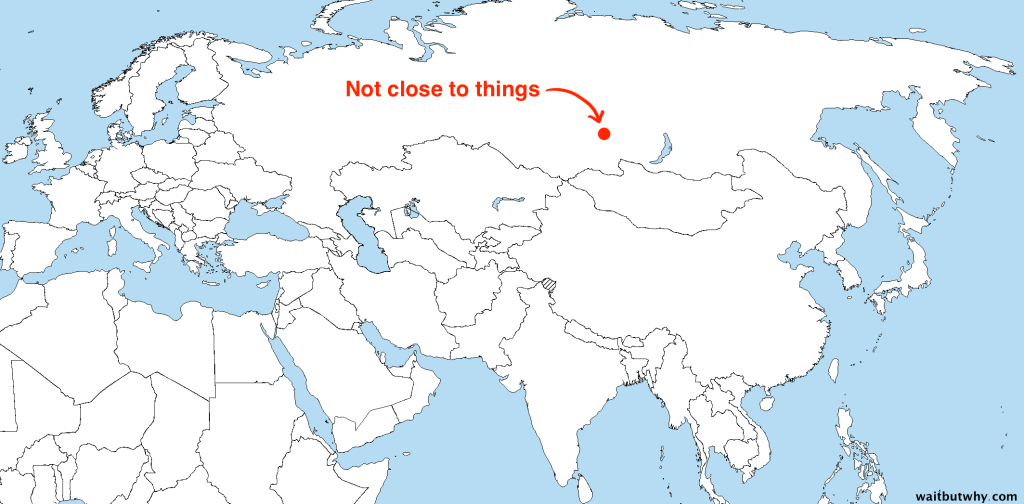
You know what’s remote? Here.

The view from the other side? Cool!
Wait But Why author shared his feelings about his visit to Russia:
A lot of cars have the steering wheel on the right side even though they drive on the right side of the road. Odd.
They don’t call it World War II, they call it The Great Patriotic War, and only talk about the 1941-1945 part of it. And most places I went to had a memorial dedicated to it. Which makes sense, given that over 20 million Soviets died in the war.
Siberia is real. I spent over half of the trip in Siberia, including taking the Trans-Siberian Railway 64 hours from Moscow to Krasnoyarsk (I highly recommend this, btw).
Siberia makes up 77% of Russia—everything but the westernmost quarter of the country—and Siberia alone would be by far the biggest country in the world if it were severed from Western Russia.
There’s no fact about Russian history that I enjoy more than that the succulent St. Basil’s Cathedral… was ordered for construction under the reign of Ivan the Terrible. Who knows what his actual feelings were about things, but I prefer to imagine him being a widely feared man who was obsessed with rainbows and colorful swirlies and anyone who ever laughed at him about this was promptly beheaded.
You know what’s remote? Here.
Read more insights on his blog: http://waitbutwhy.com/2014/07/russia-what-you-didnt-know.html
Glass columns: is it a subway station or is it a museum?
Today I'd like to share a beauty with you. Everybody knows that Moscow subway is the greatest in the world thanks to its decorations (marble, inlay, Soviet sculptures etc).
But St. Petersburg has the most amazing subway Avtovo station.


Avtovo's unique and highly ornate design features columns faced with ornamental glass manufactured at the Lomonosov factory.
Come touch them!
But St. Petersburg has the most amazing subway Avtovo station.
Avtovo's unique and highly ornate design features columns faced with ornamental glass manufactured at the Lomonosov factory.
Come touch them!
Are you strong enough?
Happy new year guys and girls! I'm still in Russia now though dreaming of traveling to India for couple of months (again).
It's cold and windy here. Yet some people surf.
On Russky Island, off the coast of Russia’s far-eastern city of Vladivostok, surfers brave air temperatures of -7 C, water temperatures of 2 C and heavy snowfall in search of the perfect winter wave...
It's cold and windy here. Yet some people surf.
On Russky Island, off the coast of Russia’s far-eastern city of Vladivostok, surfers brave air temperatures of -7 C, water temperatures of 2 C and heavy snowfall in search of the perfect winter wave...
altay2013: confluence one
Sometimes you see a picture, a story, a video, and you constantly feel that your blog is right about this.
Cheap guided tours by locals (St. Petersburg)
I found new nice startup for those who come to St. Petersburg and want to take a guided tour in English but not too touristic one.
By the way, I myself took such tours in Berlin last weekend: from New Europe and Alternative Berlin.
Here you can have the same in St. Petersburg: http://www.sptnik.com/

For example, roofing (walking on the roofs) experience for $ 21 or futuristic buildings for $12.
I'd say it's a good catch.
By the way, I myself took such tours in Berlin last weekend: from New Europe and Alternative Berlin.
Here you can have the same in St. Petersburg: http://www.sptnik.com/

For example, roofing (walking on the roofs) experience for $ 21 or futuristic buildings for $12.
I'd say it's a good catch.
Touch Russia
I want to write a line dedicated to a video project I've seen months ago and liked a lot.
It's called Touch Russia:
(or you can go to official page at Vimeo to watch it there)
It's called Touch Russia:
(or you can go to official page at Vimeo to watch it there)
Subscribe to:
Posts (Atom)