The story of a world-shaking innovative enterprise should start in a garage. The story of a flying pizza is no exception to this rule. One day in the spring of 2014, a police department in Syktyvkar, a city in Northwestern Russia, got a call from a concerned person who reported that a few suspicious young men occupied a garage in his neighborhood. They were making a lot of noise and were bothering all the respectable citizens living in the area.
When policemen arrived at the location, they did find a few people in the garage, although the crime scene looked somewhat unusual. The gang wasn’t smoking pot. There was no loud music. No half-naked girls. No parts of (probably stolen) cars could be seen. The space was instead filled with electronic equipment.
One of the men was Fedor Ovchinnikov, an entrepreneur and the founder of Dodo Pizza, a fast-growing Russian pizza chain established in Syktyvkar a few years ago. He was joined by Oleg Ponfilyonok, the founder of Copter Express, a startup company from Moscow.
The pizza guy and the сopter guy teamed up to find out how to make pizza deliveries by drones possible. The challenge was to do the real thing, for actual customers—not a performance for shooting a TV ad. Nobody had done something like this yet—not only in Syktyvkar or in Russia, but in the whole world.
The officer was evidently puzzled by what he saw. It was hard to articulate what exactly these people were doing that was against the law, since drones didn’t even exist when the law was written. He did his best to find the words to voice a complaint.
“People say that your thing is flying around at night making noise, and they can’t sleep,” he said.
“So, your recommendation for us is not to fly after eleven?” Ponfilyonok asked.
“My recommendation for you is to stop doing whatever you’re doing here,” the officer said.
Luckily (for the sake of our story of a flying pizza), they didn’t follow his recommendation. They didn’t stop.
I've seen Slava Polunin's Snow show ads in Portugal and Spain this summer. Europe will embrace Russian clown several times, as seen in his schedule. So I've decided to tell you about him.
What Is My Kind of Theatre?
or
The Theatre I Love
- It is a kind of wedding cavalcade,
where I try to marry everyone to everyone;
- It is a theatre of ritual magic
and festive pageantry,
constructed on the basis of images and movements,
games and fantasies,
that are the common creation of the audience and the people of the theatre;
- It is a theatre which inexorably grows
from dreams and tales;
- It is a theatre of hopes and dreams,
full of longing and loneliness,
losses and disillusionment;
- It is a theatre which always changes,
which breaths spontaneous improvisation
and cares scrupulously for tradition;
- It is in the vein of contemporary
multi-layered synthesis,
on the boundary of life and art;
- It is a theatre that works in an epic-intimate alloy
of tragedy and comedy,
of absurdity and naivity,
of cruelty and gentleness;
- It is a theatre which escapes
definition and the unequivocal
understanding of its actions,
as from attempts
to usurp its freedom.
Slava Polunin
Sixty-five-year-old Russian clown, Slava Polunin began his incredible career over four decades ago. According to CNN, what started out as a fascination developed into a probable career path for Polunin after he watched Charlie Chaplin in The Kid. A child at the time, he went to school in his father’s hat, boots and cane – emulating Chaplin, he made the other kids laugh all day.
Polunin became very fascinated with the way movement could convey so much emotion. He studied dances from around the world and he would imitate everything from Disney characters to kids, insane people, drunks, and animals stating, “these movements are not limited by intellect.” Polunin described his inspirations in an interview with CNN: “The perfect example is to see a child playing on a playground, or running around a forest — this is how humankind used to be originally – genuine and excited. These movements evoke a desire to follow.”
Polunin’s career has been filled with many highs including performing on state television throughout the 1970s and 1980s. It was there that he would mock authorities – making parodies out of communist restrictions – and get away with it. Because no actual words were being used, Polunin could convey important messages without actually saying them. Later in his career he created the “Academy of Fools,” an international organization uniting clowns, and “Caravan of the World,” a travelling theatre. Today, Polunin is one of the most notable clowns in the business – performing in 50 countries across the world.
But Polunin is not your average over-the-top circus clown. He puts a lot of thought into all of his actions, stating to CNN: “Today my perception of clowning is that you should be able to move just one centimeter and get a reaction from the audience as if you moved an entire mountain.” He also changes his routines based on the different countries he visits, noting that each culture has a different sense of movement and humour.
In all areas of his life, Polunin keeps the creativity and fun alive. According to Messy Nessy Chic, he even hosts visitors at his Dali-meets-Disney wonderland. And the list of oddities – including five kaleidoscopic gardens, book trees, walls you can walk through, flower beds you can sleep in, staircases that melt into the walls, giants living in trees, a giant egg house, horses with pink wings, and a Buddhist temple – is enough to make your head spin.
Polunin is going to be featured in an upcoming documentary, “Secrets of Snow – Slava’s Journey,” which will surely be a majestic and hypnotically visual ride.
Russian media tells a story about Valeriy Khramov who painted all the school #168 interiors.
Valeriy is 90. He lives in Yekaterinburg and used to be art teacher for twenty-five years. Now he is a guard there (common practice: ex-actress becomes cloak-room attendant at the theater etc) but never stops thinking of beauty, art and what children need to be taught. Now he's quitting this job and no one will take care of paintings which means they could be lost when paint will fade out.
Valeriy thought all the paintings through: one floor is dedicated to architecture (Great Wall of China, Taj Mahal, St. Basil's Cathedral), another is for geography, third one shows folk tales heroes.
Some children tell him "you're bad at painting". Valeriy tells them that painting is not everything, you have to think through ideas, connections between stories. All his paintings have stories inside, all the heroes have names and specific meanings in the interior: folk tales part, for example, sits near elementary school section.
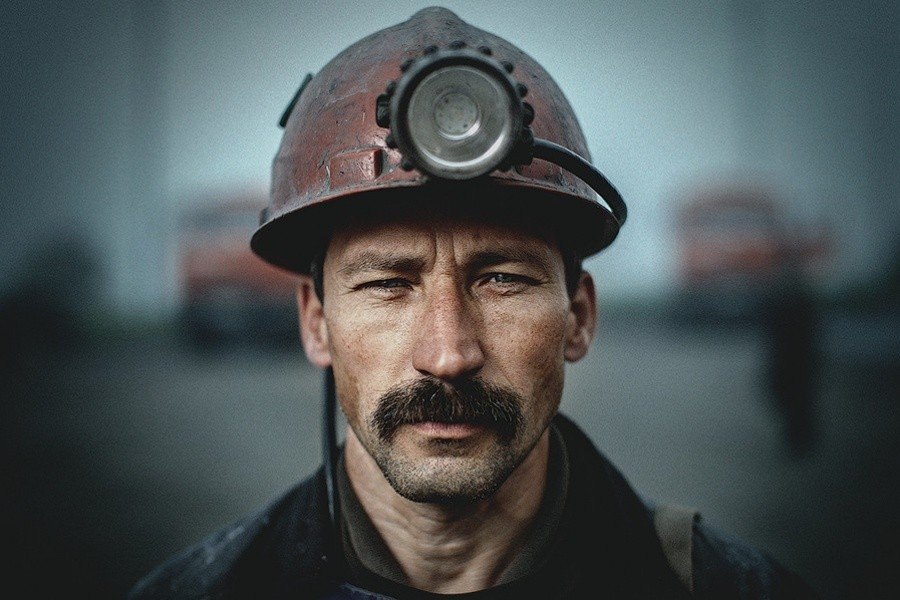
He says: I shoot miners for 3 years now and I see them as men of steel. Every time I go down there I really hope to return back to the earth's surface. I feel like I am being born again every time I come back. This is hard work guys, thank you for doing it!
Being born and raised in Moscow, I thought this is the center of the world. At least the center of Russia. Thus, Moscow should be the essence of everything Russia has. Small copy.
But it's wrong. I've learnt it by traveling, by living in St. Pete for 8 years now (which is not Russia, either). You cannot judge my country by its capital at all.
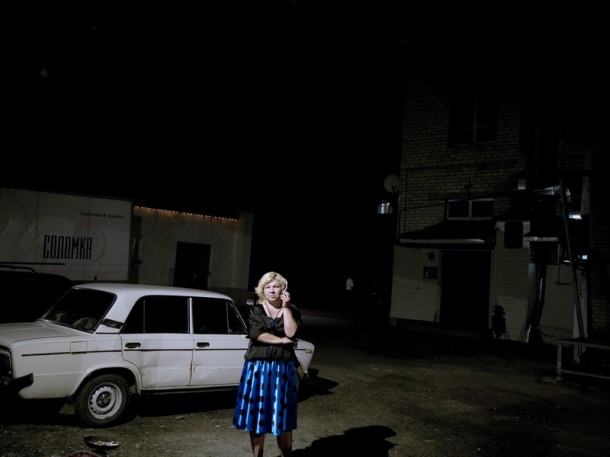
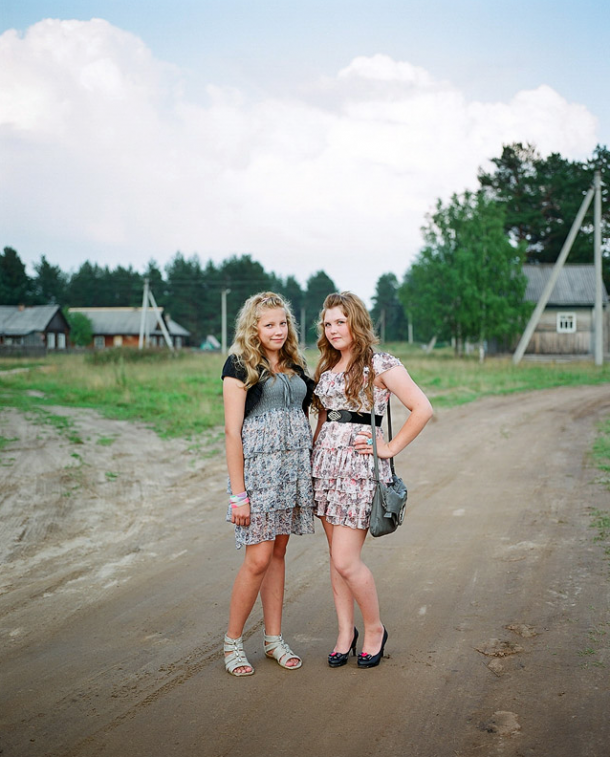
So I suggest you take a look at three photo projects (thanks to tut design for the links). Pictures were taken in small towns. This is more like Russia.
It's always amazing how people move from one country to another in pursuit for something but money and fame.
Some come to Russia with religious mission to eventually find themselves new and changed.
Yesterday friends told me about Justus Walker who lives near Krasnoyarsk (I bet you've never heard of it) and produces mozzarella cheese as a farmer with his family.
The family tells more about their history on the website. I will cite some things here:
David and June Walker answered the call of the Lord in 1993, selling their possessions and moving, with their four children to Riga Latvia where they studied Russian, preparing to work in Siberia. In 1994 the Walker family found themselves in Krasnoyarsk, a city of a million people located in central Siberia. David had always felt that the family's mission would be to minister in rural areas that had never yet heard the Gospel or had a Church. So in the fall of 1994 David and his two older children, Mycah and Justus, made several "scouting trips" to various towns and villages. By September they had discovered the town of Oseenavy Mees, in the Boguchany region north of Krasnoyarsk. The next six years were spent in ministering in Oseenavy and the surrounding towns and villages. The ministry then included pastoring the small church in Oseenavy, feeding and housing needy children, helping with adoptions, assisting in the importing of humanitarian aid, teaching English, setting up youth camps and other youth outreach programs and assisting in setting up other churches in the area. In the year 2000 the Walker family returned to the US this time to stay. Justus, however, felt led of the Lord to return to Russia and continue the ministry.
Now, personally I am atheistic person (neither do I eat mozzarella nor dairy at all) but I admire the ability to sell things, move to unknown land and do things you truly believe in. Nice job, Justus and his folks.
Do you know there is Syktyvkar city in Russia?
Or maybe you've heard of Fedor Ovchinnikov?
No and no. Then read along if you will.
Fedor says: "In 2010 I left the book business and started to look for an idea for a new business that I could dedicate my life to, which will motivate me and encourage. I looked for a project that could grow multifold. I analyzed my pros and cons, my abilities, my interests and best traits and came to an idea of a business in a food industry. I decided to work in fast food. You can read about my choice in detail here.
I intentionally chose the existing mature market of pizza delivery. There is market and demand, we didn’t need to create it. How then one can succeed at this market? How can one build a global company where there are already transnational players with much larger resources? The idea is quite simple, that is: enter the existing market but operate more efficiently at the level of an individual store, create a more efficient model! I like to create systems, tune and perfect processes. I simply enjoy it. I didn’t know yet how this business works but I was sure that I can make it better.
So in the end of 2010 before I opened my first pizza restaurant I went to St. Petersburg and worked for a month as a regular employee in fast food restaurants, including Papa John’s. This is an American pizza chain, third in the world".
Fedor says: "How to make pizza prepared as quick as they change tires in Formula 1 pit stops?
We need to create speed and excitement environment in the kitchen which is not so simple. Complex systems of long-term motivation unfortunately don’t work here.
You can beg your employees, address their conscience and promise bonuses in the end of the month but that hardly works on a cold gray morning in the beginning of the week.
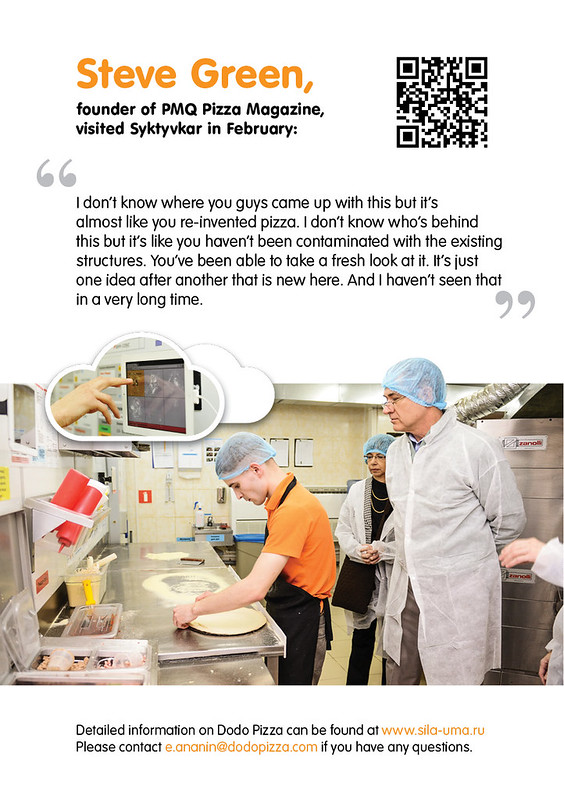
That’s where our Dodo IS information system comes into picture. It will create a system to turn the work in Dodo Pizza kitchens into global multi-user online game.
Outsiders usually say that IT in fast food is of minor significance or point out that there are plenty of out-of-the-box solutions, so there is no need to waste time and efforts to create our own system (we already invested over 1 million US $ into it and plan to invest 2 more million US $ in the next 2 years).
Well, we strongly believe that in order for IT solutions to make change these solutions…
1. should be deeply focused on one thing instead of being all-purpose solutions;
2. should deeply integrate into the production model, sometimes even change the model instead of being just an add-on;
3. and operate online in the cloud in the form of the web-application (SaaS — software as a service) instead of using operating systems and hardware.
These three key features are what makes Dodo IS different from all IT solutions by our competitors. Speed environment in the kitchen is a great case to show the advantages of our approach".