Showing posts with label art. Show all posts

Christian Guémy (C215) in St. Pete

Yesterday I got a huge portion of inspiration.


It happened in Erarta, the museum of contemporary art, during the workshop of Christian Guémy. This Parisian street artist (on the right in the photo, the man in the stripes was translating) is famous because of his meaningful stencil projects all around the world.

He was speaking on means of creativity (I've written down the whole talk in Russian), on how being creative is much the same as when you are not just a cook, but a chef. French food metaphors, you know.

I've asked Christian about him being in St. Pete for the first time. He's already been to Moscow 4 times and disliked the violent atmosphere (he showed how the passengers of the subway are kicking each other with elbows).

He said St. Pete is way more civilized, european-like city (and I can't agree more as I moved here from Moscow 9 years ago with the same thoughts).

He named Wassily Kandisky as his fav Russian artist and promised to stencil him, too.

He did that several hours later near Erarta and published on the Facebook page:


He'd also done some other typical stencils in St. Petes before the workshop, themes being "peace/world" (in Russian it's the same word, 'mir'), "love", "cats" and "Virgin":


All pictures used are taken either from my instagram, or from Christian's.

Alcohol map of kitay-gorod

I've posted works of Katya Guschina in this blog earlier. Remember her Transsib drawings?

Now she went further:
this semester in my university had a special theme. we had to create a brand for moscow. my interest in maps and alcohol (dangerous) led me to this project. i knew from my friends that the kitay-gorod area is full of bars and restaurants, so the choice wasn't hard.

the map includes several types of information: from advices by experienced people and recommended places for visiting to phrases heard on the street and suitable drinks.

the naming "blue moscow" comes from the russian tradition to call a very drunk person "blue". that's why blue is the main colour there.

I made the guide in addition to the map. It has three routes: cheap, expensive and "get drunk fast" one. On the other side there is variety of benches where you could sleep until the underground opens.

have a light hangover!


More pictures on the project page: https://www.behance.net/gallery/32603043/alcohol-map-of-kitay-gorod

How St Petersburg is creating a permanent home for street art

The world of street art abounds with irony. Supporters of this art form (which is largely predicated on defacing other people’s property) have protested plans to demolish the graffiti-covered 5 Pointz building in Queens, New York. The “outlaw” Banksy is a savvy self-promoter whose new Dismaland project, in the English seaside town of Weston-super-Mare, has been described as “the most shameless commercial art project since Disneyland”.

So perhaps we shouldn’t be surprised that this outsider art form now has its own official cultural venue in the Street Art Museum in St Petersburg, Russia. If such an institution seems a contradiction in terms for an art form that, by definition, is supposed to take place on the street, curator Nailya Allahverdiyeva seems to be its biggest opponent. “In general, I hate street art expositions, because I consider that to be a profanation of street art,” she told the Moscow Times. “I have done everything I can to drive artists out on to the street.”
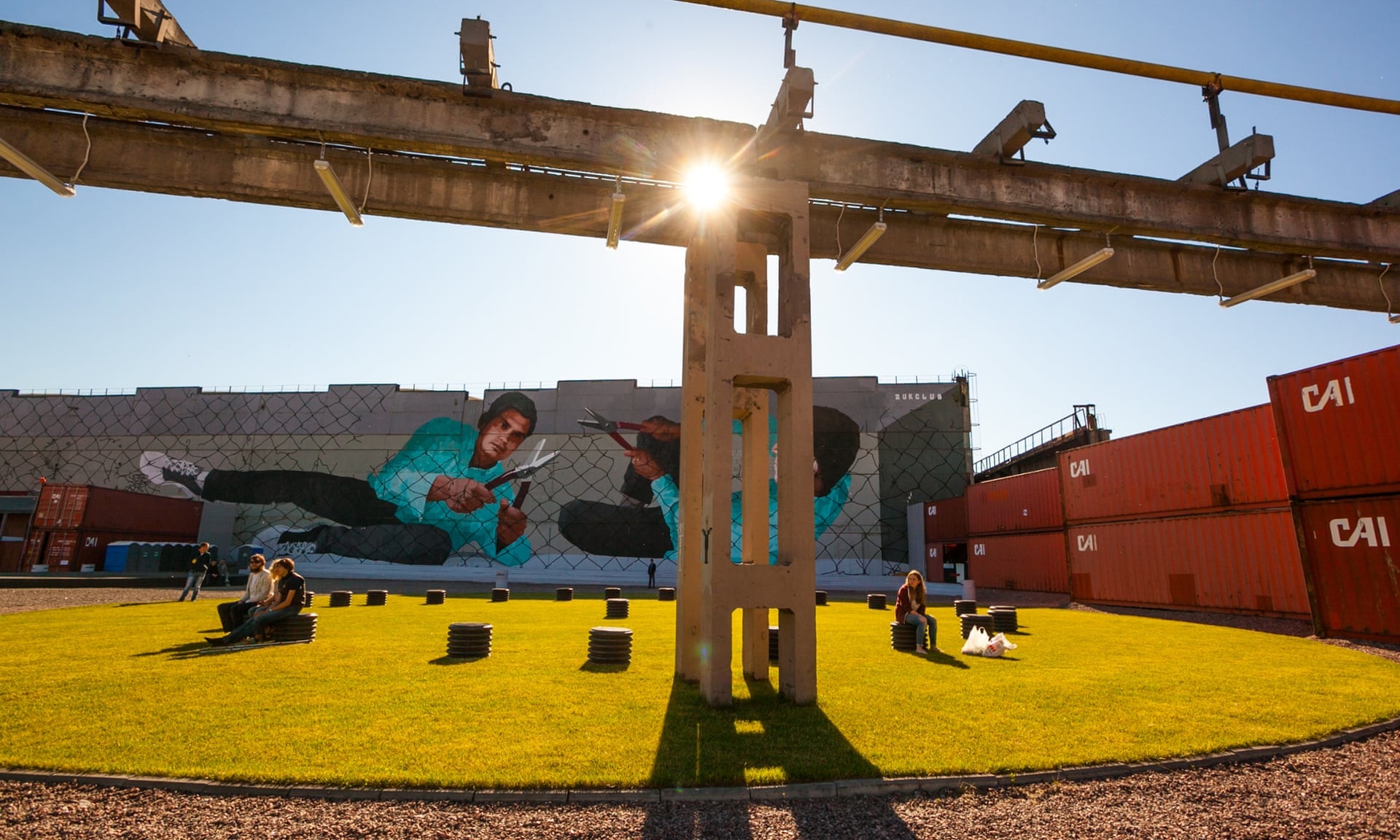


And yet, Allahverdiyeva is one of the co-curators of this year’s exhibition at the Street Art Museum. “The idea that a street art museum couldn’t exist is very popular among the people,” says Albina Motor, the museum’s producer. “But we are not a museum in the conventional sense. It’s just a name for much more.”

Most visitors looking for art in St Petersburg will check out the Hermitage or the Mariinsky theatre. The Street Art Museum is certainly not yet on the agenda – nor, as Motor says, is it a typical museum. For one thing, it’s located inside an active factory, the Sloplast plastics laminate works, in an industrial zone far outside the city’s central tourist core.

A working factory is, of course, a perfect setting for a street art museum, as factories are a typical “canvas” for street art performances. But beyond the art itself, the museum is seeking to create a cultural identity in a district that’s currently mentally, as well as physically, a world away from the city’s historic core. St Petersburg was founded by Peter the Great in 1703 as a “European-style” capital, with architecture that exudes the refined charm of western European cities. It is also endowed with a legacy of renowned cultural institutions, which help make it the most-visited Russian city for foreign tourists.

But the tourist zone in the city centre is fairly small. St Petersburg was also developed into a huge industrial centre: it is ringed with miles of factories, many of them now closed. As with many post-industrial cities, “Piter,” as Russians call it, needs to reinvent itself for a new era.

So how do you refresh an industrial district in the middle ring of this classical city? With street art, of course. The Street Art Museum engages with both functioning industry and the world of art – for which the city is already well-known. Even the museum’s logo – a spray can styled as a classic architectural column – playfully draws on the city’s high-culture reputation. But this a different kind of art for a different kind of district, one that is drawing tourists and international attention to the kind of urban zone that seldom sees much of either.

Whereas the more well-known institutions in St Petersburg are oriented towards the past, the Street Art Museum is engaging with the present – not just in terms of street art, but also contemporary issues facing Russians. Vladimir Putin’s authoritarian turn has lent a degree of seriousness and importance to Russian street art that transcends the mere posturing and thinly veiled commercialism too often present in the west. Examples range from the anti-Putin works of the late P183 to the street performance of art-collective Voina.

It was the factory owner himself, Dmitry Zaitsev, who created the museum, and his son Andrey is the museum’s director. Because it’s in a factory, a good deal of the “permanent collection” comprises murals overlooking active factory floors full of workers, such as God at Work by Roman Kreemos or Supreme (in homage to suprematism) by Petro.

“The original idea was to make this place cosy for working,” says Motor, highlighting the industrial logic behind these works, which are normally off-limits to museum-goers and require special advance arrangements to see. The relationship between factory and museum goes the other way, too: the chairs in the museum cafe were made from the factory’s products and assembled by its workers.

But is street art something the workers actually like, or just something the creative class thinks they should like? Motor recalls a conversation between two workers about street artist Kirill Kto’s artwork Sometimes Yes, Sometimes No: “Sometimes yes, sometimes bullshit” – a sentiment to which anyone who’s ever been to a museum can probably relate.

A massive outdoor area and decommissioned parts of the factory, like the boiler house, are used for temporary exhibits, such as The Cage by Zuk Club, Toy Group’s humorous “flyers”, or an enormous wall-sized manifesto called Everything I Know About Street Art by Timothy Radya.

The venue also provides street artists with the opportunity to work experimentally in forms they have never used before, and the space to create work that won’t immediately be disregarded as disposable. For example, Andrey Olenev exhibits a series of charred logs that encircle a room. The charred smell is still present, lending an extra dimension to this piece – and, as with many of the best works of contemporary art, it has an ambiguity that captures your attention: it is not immediately obvious whether it is art or debris, or indeed exactly which parts of the room are art, which are “gallery” and which are factory. You can’t simply drift past these exhibitions like so many paintings on a wall.

Could the idea catch on? A group in New York called the Street Museum of Art tours exhibits on the street, while Amsterdam’s Street Art Museum is a walking tour. The V&A in London has a street art collection, and there are plans afoot for something similar in New Jersey; but, in general, the paradoxical nature of the idea helps explain why the Street Art Museum is the first of its kind.

Meanwhile, as with all street art, it’s an idea that is constantly changing, as the gallery mixes up the collection, and the fortunes of the factory itself fluctuate. “Some people think that museums are kind of cemeteries for art,” Motor says. “We have no intention of becoming a graveyard for street art.”

(from The Guardian)

Viktor Schnayder: naiv art

Viktor Schnayder from Orenburg was one of Naiv painters. I haven't found any paged about his work in English... or in Russian. So few things left online from some people.

Anyway, he was amazingly honest and his works show a lot about Russia and even about Russian soul.

This picture is called 'Occupation'. Not as in job title, but as military occupation.


These show farmers' life:


More of his work could be found here.

Zoya Cherkassky: Soviet past

Zoya Cherkassky was born in USSR and now lives in Israel. Lately she created several works explaining everyday life of every soviet teenager. They look so close to what I personally remember.

Family gathering:


Vacuum cleaning:


Picking leaves in autumn:


Morning, winter, preparing to go to school:


At school:


Read more about artist here.
Her facebook page is here.

Great russian artists and photographers to know

Jean-François from Paris asked:
I would be interested to get your point of view on great russian artists and photographers to know. I am also wondering how is the daily life for people, what are the things that people are interested about, wondering also how people are concerned about politic and the russian position with other countries.

Hello Jean-François! I mean bonjour.

I've already mentioned some of Russian artists on the blog.
Look: photographers, artists and some art.
Now I'd like to speak about another one.


Have you heard of Wassily Kandinsky?

Like Picasso, he started with very natural-looking images...


And then "went nuts" in his own amazingly vivid way:


He was sure that it's possible to avoid form and tell a story with free-splashed colors.

He wrote on composition, color, perception and creativity. I enjoy his logical and sensible way of thinking about art.

Wassily Kandinsky: Concerning the Spiritual in Art
Point and Line to Plane


As for other questions, I'll be brief.

How is the daily life for people?

It's not so unusual from European point of view. In a city, they run around and work, in a village, they try to survive. They marry, die, fall in love, make children and learn new things. And watch TV, most of they do.


What are the things that people are interested about?

With recent currency jumping mostly they are interested in earning more and spending more. Working, going on vacation, spending time with beloved ones, have fun. Really it's not that unusual.


How people are concerned about politic and the russian position with other countries.

Mostly people are disoriented and try to believe everything will magically get back to normal. And if they watch TV, they know it's gays, jews, europe, america, whatever - others are to blame for problems, not themselves. It's quite sad. Blaming others instead of making the world better. But it's so common now.


This post is an answer to one of The Listserve replies I’ve got.
You can ask your question, too.

Nasreddin in Russia newspaper

Olga Zhitlina and some other artists collaborated for a nice piece on working migrants in Moscow and/or Russia.

Olga Jitlina – art and editing
Anna Tereshkina – art and illustrations
Thomas Campbell – translations
Supported by the Academy of the Arts of the World, Cologne
This newspaper recounts how Nasreddin Hodja, a folk character renowned for his wit and talent for getting out of difficult situations, and famed from Akşehir to the Pamirs, from Bukhara to the Balkans, went to work in Russia. Or rather, it recounts how we, a group of artists and migrant workers, looked for Nasreddin’s qualities in each other and ourselves.

There are three issues of 'Nasreddin in Russia' newspaper (Nasreddin means satirical Sufi) and all of them are bilingual.


Painters of ordinary St. Pete

You know Hermitage. Those paintings you see also in Prado, Louvre and many other places around the world.

But where to find paintings never been installed in a city museum? Where to find unfinished works, hidden in the artist's workshop before, never shown away? Where to see what real artists do right now and what they've done during USSR years while not painting for government? Where to understand what artists of St. Pete paint when they think about their beloved city or entire country?

I know right the place.
It's cozy cultural/art centre also. Many musical and creative things are being held there throughout the year (including Krugovorot clay show I've already told you about).


You get the atmosphere of the private gallery here, cheap entrance fee and even guided tour by staff inside. Free wi-fi and nice people included.
It's also a nice thing to do during rainy or snowy days.

This is it: facebook.com/StPetersburgArt.

Now take a look at some pieces from the exhibition:


And this is my personal favorite: