Showing posts with label petersburg. Show all posts

Christian Guémy (C215) in St. Pete

Yesterday I got a huge portion of inspiration.


It happened in Erarta, the museum of contemporary art, during the workshop of Christian Guémy. This Parisian street artist (on the right in the photo, the man in the stripes was translating) is famous because of his meaningful stencil projects all around the world.

He was speaking on means of creativity (I've written down the whole talk in Russian), on how being creative is much the same as when you are not just a cook, but a chef. French food metaphors, you know.

I've asked Christian about him being in St. Pete for the first time. He's already been to Moscow 4 times and disliked the violent atmosphere (he showed how the passengers of the subway are kicking each other with elbows).

He said St. Pete is way more civilized, european-like city (and I can't agree more as I moved here from Moscow 9 years ago with the same thoughts).

He named Wassily Kandisky as his fav Russian artist and promised to stencil him, too.

He did that several hours later near Erarta and published on the Facebook page:


He'd also done some other typical stencils in St. Petes before the workshop, themes being "peace/world" (in Russian it's the same word, 'mir'), "love", "cats" and "Virgin":


All pictures used are taken either from my instagram, or from Christian's.

You're not the real muscovite

— Those Muscovites! — my colleague spills the angry word.

I raise the eyebrow.

— Not you, — he corrects himself. — You're not the real muscovite. You're like us.


**
"Us" and "them", this everlasting confrontation in every Russian soul who have been born in USSR.

This time it’s about the cultural differences in two major cities. I’ve lived in both.

Moscow folk: uber-efficient, fast-responsive, overworking and loud in self-presentation.
The driver is excellence. And money, of course.

St.Pete folk: quiet, intelligent, thoughtful, snobbish, respectful, intellectual.
The driver is connection. Not the money. You can get along without high income here (never in Moscow).


**
I’m riding the city bus in St. Pete.

— Have you ever been to Moscow?

I turn off my pink iPod to enter the conversation. Ticket-collector lady is waiting for my answer.

— Yes, I did.

— They do not speak on the bus! Never.

— Maybe they don’t have time. They are always in hurry, — I offer the common reason.

She nods. I smile.

Could she guess I was born in Moscow? Probably not. I’m living here for nine years already.

**
St. Pete was built by the powerful man, Peter the Great (he also loved the titles, as any tzar should).

I mean, St. Pete was built by the people of his country. Peter ruled feverishly, installing new (European-like) rules and changing the whole game play.

He moved the capital from Moscow to St.Pete in 1712. He borrowed many ideas from the Netherlands. He was thinking strategically. He used a lot of human resources to build a city «on their bones» (as history books say). It was all the swampiness and nothing else here before Peter came.

He founded the city on the swamp, he named it after himself, he «cut the window to Europe», promoted secular education, he sent youngsters to study abroad, insisted on translating books and founded the modern newspaper. It’s amazing how good deeds go along with brutal, even butcher actions. You cannot like or dislike a power of this sort, you’re just amazed by it. It’s really impressive, how much have been done — and how many have suffered in the process.

Then he died. Even the most powerful ones are just humans in the end.

In 1728 the capital status was returned to Moscow alongside with all the government moving back (and many Peter’s initiatives sweeping under the rug).

What was that? A glimpse of the parallel universe, a star from the unknown future, a missed opportunity, a wrongful direction?

All that we are left with is St.Pete.

Italian-like (it was built in stone with Italian architects), breezy (wind lives here all the year round), grey and cold, romantic and intellectual city. The cultural capital. The Northern Venice. The city I now live in.


**
— I’ve been thinking and I still can’t get why do you live here, — a friend recently said to me. This conversation happens all the time but with different people.

— I cannot explain. I like it here. Moscow is so crowded, so hurried-up, so loud.

— But the weather… the winters are so long… the sky is dark...

— We call it «nine months of winter».

— The white nights in the summer are so disturbing! It’s impossible to sleep when there’s light outside!

— But then we have «dark days» in the winter if you miss the darkness. It’s daytime only from 12 noon to 3 pm.

— I don’t understand.

— I just love it.

Weird design: apartment block with "chicken legs"

This apartment block has 22 floors and 221 apartments. It's situated in St. Pete (see on Google maps). It was built in 1988.


More pictures of this remarkably grey building, including of apartments, you can find in this Russian article.

A Bright Future - New Works from Russia

Canadian architect turned photographer David Burdeny presents a collection of images showcasing the stunning and elaborate Moscow and St. Petersburg Metro system in A Bright Future - New Works from Russia.

The photographer spent two weeks shooting the aesthetically amazing stations and, as far as he's aware, remains the only photographer in the world to have been granted permission to shoot at these locations after they had been emptied of passengers.

It took over a year for the photographer to gain permission to pursue this project, and he was forced to rent the stations by the hour and shoot only after midnight.


This station is my favorite, sometimes I come there just to look at these glass columns and to touch them:


source: http://hyperallergic.com/242843/opulent-propaganda-the-subterranean-paradise-of-the-moscow-metro/

Subway employees, St. Petersburg

Soon there will be photo exhibition full of official subway peeps' shots. A couple of photographers worked for 6 months taking pictures of underground workers.

Just look at them:


How St Petersburg is creating a permanent home for street art

The world of street art abounds with irony. Supporters of this art form (which is largely predicated on defacing other people’s property) have protested plans to demolish the graffiti-covered 5 Pointz building in Queens, New York. The “outlaw” Banksy is a savvy self-promoter whose new Dismaland project, in the English seaside town of Weston-super-Mare, has been described as “the most shameless commercial art project since Disneyland”.

So perhaps we shouldn’t be surprised that this outsider art form now has its own official cultural venue in the Street Art Museum in St Petersburg, Russia. If such an institution seems a contradiction in terms for an art form that, by definition, is supposed to take place on the street, curator Nailya Allahverdiyeva seems to be its biggest opponent. “In general, I hate street art expositions, because I consider that to be a profanation of street art,” she told the Moscow Times. “I have done everything I can to drive artists out on to the street.”


And yet, Allahverdiyeva is one of the co-curators of this year’s exhibition at the Street Art Museum. “The idea that a street art museum couldn’t exist is very popular among the people,” says Albina Motor, the museum’s producer. “But we are not a museum in the conventional sense. It’s just a name for much more.”

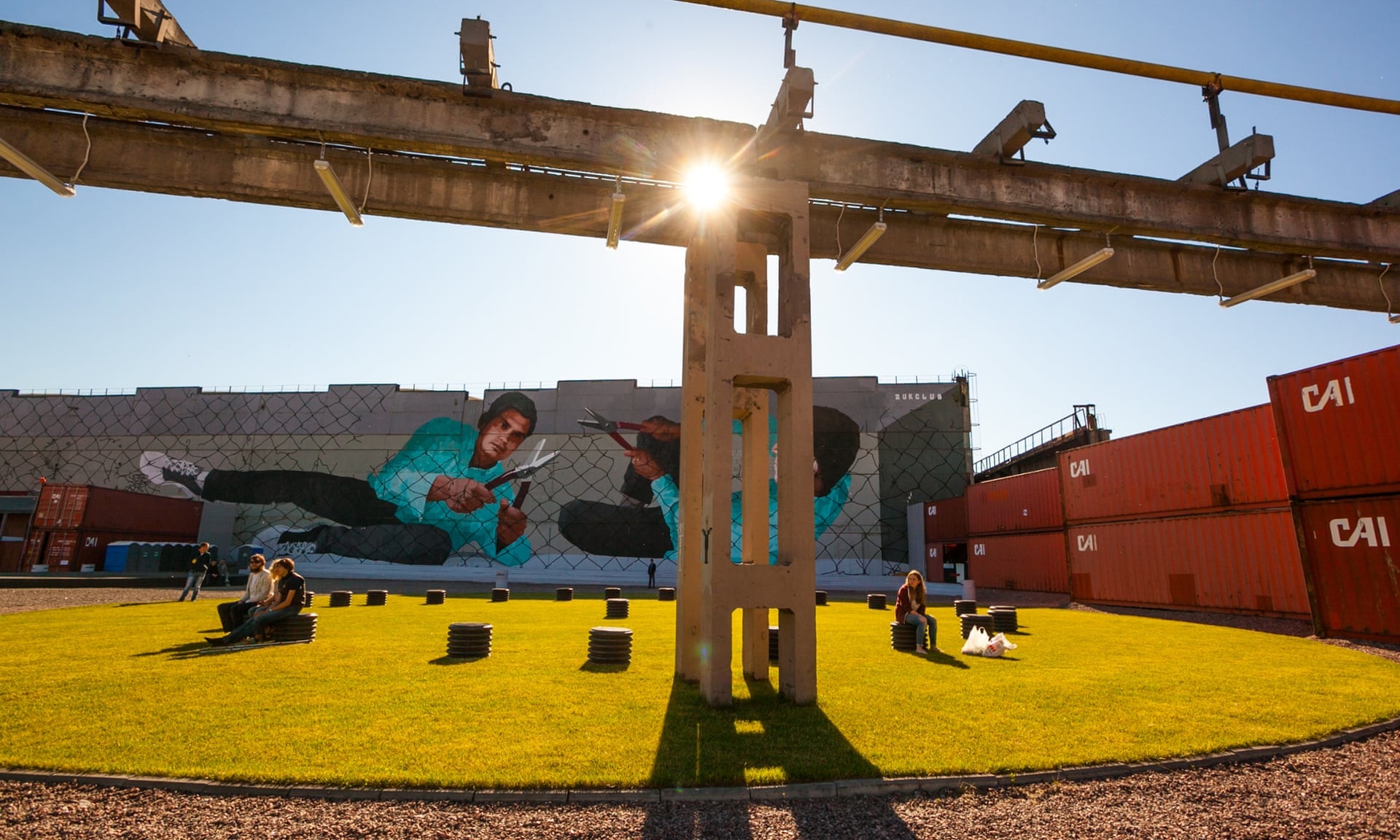
Most visitors looking for art in St Petersburg will check out the Hermitage or the Mariinsky theatre. The Street Art Museum is certainly not yet on the agenda – nor, as Motor says, is it a typical museum. For one thing, it’s located inside an active factory, the Sloplast plastics laminate works, in an industrial zone far outside the city’s central tourist core.

A working factory is, of course, a perfect setting for a street art museum, as factories are a typical “canvas” for street art performances. But beyond the art itself, the museum is seeking to create a cultural identity in a district that’s currently mentally, as well as physically, a world away from the city’s historic core. St Petersburg was founded by Peter the Great in 1703 as a “European-style” capital, with architecture that exudes the refined charm of western European cities. It is also endowed with a legacy of renowned cultural institutions, which help make it the most-visited Russian city for foreign tourists.

But the tourist zone in the city centre is fairly small. St Petersburg was also developed into a huge industrial centre: it is ringed with miles of factories, many of them now closed. As with many post-industrial cities, “Piter,” as Russians call it, needs to reinvent itself for a new era.

So how do you refresh an industrial district in the middle ring of this classical city? With street art, of course. The Street Art Museum engages with both functioning industry and the world of art – for which the city is already well-known. Even the museum’s logo – a spray can styled as a classic architectural column – playfully draws on the city’s high-culture reputation. But this a different kind of art for a different kind of district, one that is drawing tourists and international attention to the kind of urban zone that seldom sees much of either.

Whereas the more well-known institutions in St Petersburg are oriented towards the past, the Street Art Museum is engaging with the present – not just in terms of street art, but also contemporary issues facing Russians. Vladimir Putin’s authoritarian turn has lent a degree of seriousness and importance to Russian street art that transcends the mere posturing and thinly veiled commercialism too often present in the west. Examples range from the anti-Putin works of the late P183 to the street performance of art-collective Voina.

It was the factory owner himself, Dmitry Zaitsev, who created the museum, and his son Andrey is the museum’s director. Because it’s in a factory, a good deal of the “permanent collection” comprises murals overlooking active factory floors full of workers, such as God at Work by Roman Kreemos or Supreme (in homage to suprematism) by Petro.

“The original idea was to make this place cosy for working,” says Motor, highlighting the industrial logic behind these works, which are normally off-limits to museum-goers and require special advance arrangements to see. The relationship between factory and museum goes the other way, too: the chairs in the museum cafe were made from the factory’s products and assembled by its workers.

But is street art something the workers actually like, or just something the creative class thinks they should like? Motor recalls a conversation between two workers about street artist Kirill Kto’s artwork Sometimes Yes, Sometimes No: “Sometimes yes, sometimes bullshit” – a sentiment to which anyone who’s ever been to a museum can probably relate.

A massive outdoor area and decommissioned parts of the factory, like the boiler house, are used for temporary exhibits, such as The Cage by Zuk Club, Toy Group’s humorous “flyers”, or an enormous wall-sized manifesto called Everything I Know About Street Art by Timothy Radya.

The venue also provides street artists with the opportunity to work experimentally in forms they have never used before, and the space to create work that won’t immediately be disregarded as disposable. For example, Andrey Olenev exhibits a series of charred logs that encircle a room. The charred smell is still present, lending an extra dimension to this piece – and, as with many of the best works of contemporary art, it has an ambiguity that captures your attention: it is not immediately obvious whether it is art or debris, or indeed exactly which parts of the room are art, which are “gallery” and which are factory. You can’t simply drift past these exhibitions like so many paintings on a wall.

Could the idea catch on? A group in New York called the Street Museum of Art tours exhibits on the street, while Amsterdam’s Street Art Museum is a walking tour. The V&A in London has a street art collection, and there are plans afoot for something similar in New Jersey; but, in general, the paradoxical nature of the idea helps explain why the Street Art Museum is the first of its kind.

Meanwhile, as with all street art, it’s an idea that is constantly changing, as the gallery mixes up the collection, and the fortunes of the factory itself fluctuate. “Some people think that museums are kind of cemeteries for art,” Motor says. “We have no intention of becoming a graveyard for street art.”

(from The Guardian)

Rotonda na Gorokhovoy

I helped guides from Rotunda with leaflet translation. They seem to be ready welcoming English-speaking guests which is wonderful as there is no place like Rotunda.


From the outside it's typical old city building with tenants but the inner round porch is amazingly unusual. Drop by and check it out. The entrance is not free (the fee about 50 RUR goes into printing leaflets and cleaning porch). The door is usually closed but there always is someone to guide you (and there is his phone number on the door to call guide if he is inside with other guests).

See map directions here, scroll to read the whole story.


Rotunda. A door to another dimension (Yevment’ev’s building) 

Alexey Kvasov was the Chief Architect of Building Commission in St Petersburg. He’s been responsible for all stone building development in 18th century. Would he anticipate to be known in 21st century mostly as creator of small revenue house on Fontanka river embankment? Even more, would he say this particular revenue house will be a place for underground artists or that the inner Rotunda porch will be named «Devil’s stairway», «door to another dimension», «center of all things»?

Myths and legends embrace this average green (from outside) building for dozens of years. They say masons had their meetings here, on inner steps. They say this place was mentioned in «War and peace» as a spot of Pierre Bezukhov’s initiation (although there is no proof in the novel).


In 19th century (1860s to be exact) dancing master Martsinkevitch (1) bought this building and started its musical history. First «Martsinki» dance class, then «Public dance hall of Alexandrov», then «Entertainment by Tumpakov», then «Cabaret show hall»… then revolution came and entertainment was shut down at 1918.

On another side of Gorokhovaya street in 64th building lived famous Grigori Rasputin. They said he messed with some magic (and girls, and gold — the whole bunch) in his own house but he went to Rotunda to practice some additional witchcraft. Maybe there was some brothel.

Communists were super efficient in making people move to new places and make them live in unusual circumstances. For some reason Candlemas church was moved to Rotunda for couple of years, held some services and was closed in 1920s.


Rotunda rises again in history books at the end of USSR era. This circle hall became home for underground people in 1970s. Rock bands, hippies, hitchhikers, Saigon’s (2) haunters and other counter-culture folk. Why? First, location was a killer. Close to Saigon, The Pipe (3), Kazantip (4) and other major city spots. Second, flea market Apraksin Dvor was close which made it possible to come and get («ask», as those hippies said using this word in English as a Russian one) free cigarettes, free food and even money from people who shopped there. During summer Rotunda’s new unofficial owners raided nearest garden, during winter they stayed inside the porch on the inner stairs thanks to central heating.

Collective memory of St. Pete’s System (5) holds some of the residents' names dear. Rotunda’s guest list was huge, there is a quantity of underground celebrities inside. Let’s check one by one: poet Alexander Bashlachev, rock-star Konstantin Kinchev, punk singer Yanka Dyagileva, rock-musician Yuri Shevchuk, members of Piknik rock band, members of Auktyon band… We are not sure if it is all true but it might be. Many of people mentioned (those who are still alive) speak on the subject of Rotunda and share warm memories. It was warm here physically — and mentally. You could meet nice people, maybe your friends, share a cigarette and a story, listen to some new song, drink beer or get weed, speak on awareness and purpose of life...

Thus «center of all things» nickname of Rotunda emerged. It was ironical but secured Rotunda’s status as a source of vital and rare information for those who understand. «There is energy boost, it comes through Rotunda, right in the middle, do you feel it? Some people do» — Rotunda residents shares.

One of visible Rotunda's features is multitude of hand-written notes all over the place. Short and long, in prose of lyrical, funny and tragic, they create unique verbosity of System, sometimes starting to talk to each other:

— But walls are virgin as fresh snow,
I whisper to hand-rails (and get no answer)
that I would really like to hear another
guitar’s or violin’s or any laughter.
But they keep quiet as they don’t care
and I'm worried deep inside.
Oh God! Oh God! I’ve never felt
such loneliness of heart.

— You’re not lonely! We’re here. Waiting for you. Ira and Masha.

(From Rotunda’s wall, year 1988)


These hand-written notes on the walls are often deeply connected with System’s legends and have no meaning for a passer-by. Sometimes Third would be mentioned («Who is going to be Third?», «You will find dead body in this wire loop if Rotunda dies. The Third», «Go Trird!» etc — some of graffitis from years 1987-88). It all comes clear if you know that two suicides have happened in Rotunda before, both used long wire, and they were posthumously named «First» and «Second» by Rotunda’s residents.

Some myths come from unusual architectonics. Six detached columns coming to the bowl at the third floor level with short metallic railing. They create independent space inside the round hall. It looks like second circle with open borders. Two sets of spiral stairs come from the center and embrace walls with their cast-iron hand-rails. They end at the landing with specific acoustic features. You can hear everything from the stairs but there will be no echo. There are some specific spatial features, too, because people standing on the landing are not seen from outside.

But time has the most specific features in Rotunda. There is a legend that you cannot reach landing if you closed your eyes and went up the stairs: Devil’s stairs go nowhere. Another myth tells us about a boy who went to the basement for 15 minutes... it added him 70 years.

Rotunda drew attention of many, not only rock music lovers and hippies. Some legends say this place heals non-mutual love so many enamored came to write their wishes on the walls, to seek help from unknown yet powerful. Some people say that Rotunda stays in the center of a pentagram: five other city rotundas — which led to satanist and esoteric visitors.

In 1988 walls of Rotunda were whitewashed. Residents were terrified. «Rotunda dies! Let’s save Rotunda! It’s only alive if we are!». But the real end of System's era in Rotunda was stimulated by another cause. New century came and new underground cultures replaced old ones. 

Now the Rotunda’s round porch attracts another people. To be honest, almost everyone. Savvy tourists, rock fans, magic lovers and every visitor willing to read all the wishes from these walls. Comparing old graffitis to new ones we adore simplicity of new style: «I want sex», «I want money», «I want grade with distinction» (years 2001-2012).


Insert #1
Historical notes

1760-1790 — architect Alexey Kvasov creates Semenovskaya square architectural ensemble

1780s — future Rotunda building is being built (Fontanki embankment 81 / Gorokhovaya 57) as a revenue house for merchant Savva Yakovlev

1856 — Rotunda is being reconstructed, cast-iron hand-rails appear with the project of architect E. Wintergalter

1860-1918 — people are having fun at various entertainment venues of the building

1990s (till 1917) — the owner of the building is merchant Alexander Yevment’ev (his name is written near Rotunda in the historical monuments' list of St. Pete now)

1970s — 1990s — Rotunda and Saigon are favorite spots for undersground and System’s residents

1990s — our days — Rotunda as unofficial pilgrimage site for those who love mystical stories, last-century scent, rock music.


Insert #2

Hello Rotunda, my dear.
I’ve no other place to go.
They don’t understand my pain,
I've come to your place again.
Hello Rotunda, my shelter
My temple of love and respect
I vanish in your atmosphere,
I close every door of myself...

(graffiti, 1998 (1,82))


References

1. V. Toporov «Texts and myths of St. Petersburg», 1995, pages 368-400
2. T. Schepanskaya «Young communities», 2003, pages 34-85


Footnotes

(1) There were two people with surname Martsinkevitch. Do not mix them up. One is Kazimir Martsinkevitch from 19th century and another is gypsy singer Alexander Martsinkevitch, famous in 1990s. Some people think second Martsinkevitch had gypsy dance classes in Rotunda building for street gangs during perestroika which is utter nonsense.

(2) Saigon was unofficial cafe name. It united all the city underground peeps from 1964 to 1989.

(3) The Pipe is slang for one of pedestrian subways under Nevsky avenue. Underground music bands were performing there.

(4) Kazantip was slang for Kazan cathedral yard. Underground music concerts, meetups and other gatherings were held there.

(5) System was endonym (self-given name) for a huge amount of Soviet hippies and underground peeps at 1700s-1800s.

St Petersburg is a Russian revelation, says Nick Boulos from Express (UK)

Let's read together:
Despite the late hour, a large crowd had gathered along the attractive embankment of the Neva River. Couples stood near groups of friends strumming their guitars, while on the river a steady stream of boats ferried tourists up and down the wide waterway. The sight of St Petersburg glowing under the midnight sun was spellbinding.

As the time fast approached 1:30am, the city’s famous Palace Bridge opened to allow boats to travel upstream. Above the city’s most historic and handsome buildings – on one side the pointy gold-topped Peter and Paul Cathedral and on the other, the pastel green walls of the Winter Palace – the sky remained midnight blue.

Summer is a special time in Russia’s second, and most elegant, city. It’s also quite a revelation and not what you might expect from a weekend in the world’s largest country. There’s neither a snowflake nor a fur coat to be seen. Instead, it’s dominated by “white nights,” a phenomenon in which the sun never quite sets.

Located on the Gulf of Finland, the city was founded in 1703 and became the Russian capital a decade later – an honour it held until 1918 when Moscow was reinstated as the country’s capital.

The long and balmy days show the city at its best, with ample time to cruise the canals, roam the museums, seek solitude in the churches and get tipsy on shots of vodka… this is Russia, after all.

But there are surprises far beyond the weather. Strolling down Nevsky Prospekt – St Petersburg’s equivalent of Oxford Street – I was struck by just how, well, un-Russian the whole place felt. Aside from a few Soviet touches on the outskirts, the city’s historic heart is, upon first glance at least, every bit as European as Vienna or Budapest.

In comparison, Moscow – 450 miles away – is Russian through and through, its skyline dominated by formidable Stalinist architecture and the high red walls of the Kremlin. Softer St Petersburg is a perfect introduction to this intriguing and often intimidating country.

My first stop was the acclaimed Hermitage Museum, home to arguably the world’s greatest collection of art. Spread across five buildings, including the exquisite Winter Palace, built in the early 18th Century by Peter the Great, you could easily spend days wandering around the gilded state rooms, admiring works by Picasso and Matisse among others.

If the Hermitage showcases international masterpieces, the nearby Russian Museum pays tribute to local artists past and present. The most impressive treasures of all, however, were on display across town at the new Fabergé Museum in the Shuvalov Palace.

Among the 4,000 pieces on display are a dozen or so Easter eggs made for the imperial family by legendary Carl Fabergé in the late 20th Century. These are no ordinary Easter eggs. Each individually designed and worth millions of dollars, they feature diamonds, gold, rhinestones and silver and open up to reveal a surprise within. My favourite was an egg of transparent yellow enamel, made in 1897 to celebrate Nicholas II taking the throne. Hidden inside is a miniature replica of the carriage used by the tsar at his coronation.

I took stock of these varied treasures over a coffee at Kupetz Eliseevs, an ornate art nouveau food hall with chandeliers hanging from a giant pineapple-esque palm tree in the centre of the room. Milling around, local foodies picked up pricey bottles of vodka and closely inspected tins of Beluga caviar.

I indulged in these two most Russian of delicacies at the Belmond Grand Hotel Europe, home to St Petersburg’s only caviar restaurant. Delicate blinis, each topped with tiny glistening balls of fishy decadence, were presented alongside glasses of potent Siberian vodka.

Thankfully, I didn’t have very far to stumble home. This landmark property dates back to the 1820s and briefly enjoyed a stint as a hospital during the Second World War when Leningrad, as it was then, was under siege.

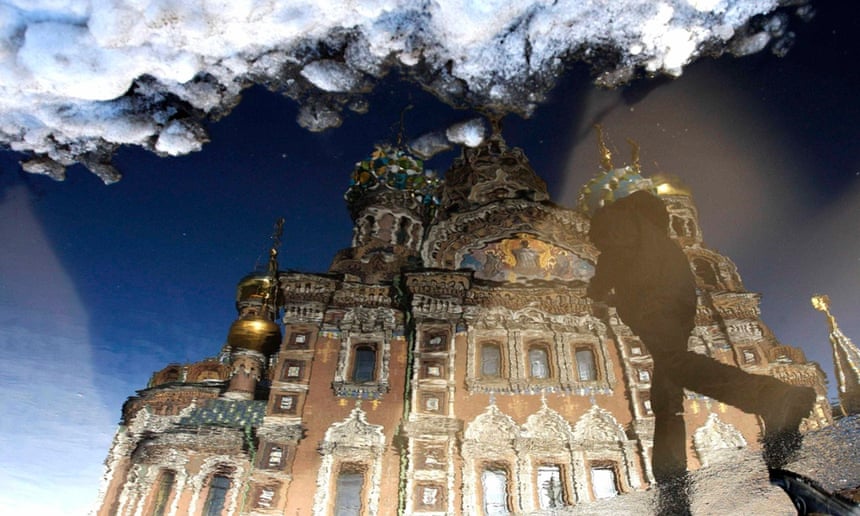
Just around the corner from the Grand Hotel Europe is the jewel in St Petersburg’s sparkling crown: the Church of the Saviour on the Spilled Blood. Its whimsical onion domes – swirling shades of blue, green and white – loomed against the clear blue sky. Inside, gold reigned supreme. Following a restoration that lasted almost 30 years, it reopened with intricate mosaics of religious scenes and figures decorating every inch. Its unusual name comes from the assassination of Tsar Alexander II that took place here in 1881.

Boats sped along the canal just outside the church. Gliding past the parks and palaces, the castles and neoclassical riverside buildings was a pleasant way to experience the city from a different perspective and a beautiful way to end my time in Russia’s understated but most charming second city.
Source: http://www.express.co.uk/travel/articles/599569/Russia-most-beautiful-city-St-Petersburg

Are Petersburg and Moscow so very different from other Russia?

Abraham from Chicago asked:
How do you feel like you relate to the rest of Russia, as a resident of St. Petersburg? Do you feel like the Russia of Petersburg and Moscow is very different from the rest of the enormous country, or do you see more similarities than differences, having traveled pretty far outside Russia?

And: I've never been to Russia, but I have been to Belarus (mostly Minsk and some time in Mogilev and the countryside). There, I met many people who thought of Belarus and Russia as essentially the same country, temporarily split apart. But how do you see Belarus?

Hello Abraham!

Once I’ve been steady Muscovite (I was born and raised in Moscow). I cherished the thought to be privileged to live in the best place. Everyone came to the capital for success, money, apartment, career — it happens in any country, I guess.
I felt I already have everything I needed.


Then I finished studying and moved to St. Pete. Now I love this city even more. It’s the second biggest city in Russia, ‘cultural capital’ (it was the capital earlier but then government moved to Moscow). This city is nothing like Moscow or other Russia. It feels like Europe here. I enjoy living in St. Pete.


And yes, the rest of the country is very different from both thesw cities I’ve lived in. I traveled around Russia and can tell for sure. More differences than similarities.
See also: Moscow is not equal to Russia post.

As for Belarus, I’d say it’s rather closed and well-controlled country. People are so similar to those who live here. But they live differently because of hard political and economical conditions. Even harder than here. The good thing for Russians is everyone will understand them in Belarus.

But these are two different countries anyway. For example, it’s hard to hire Belarus citizen in Russia officially. I don't feel myself home in Belarus.


This post is an answer to one of The Listserve replies I’ve got.
You can ask your question, too.

City bday

Today my city is 312 years old. Many projects flourish because of this, even yarnbombing-ish ones.

But I'd like to show you something else. Pictures of old VS new Petersburg.
These pictures are interactive, you can go to source directly and play with them. No knowledge of Russian language needed.


Source: http://paperpaper.ru/inter-piter/


City of white nights in timelapse

Saw this video yesterday in one of our fav restaurants. So beautiful, my city. Come visit.

Spelling Russian subway stations

Best tools are both useful and fun. This describes Alternative Metro map project which could help anyone who comes to Moscow or St. Pete not knowing Russian words but willing to take subway.

Russians use cyrillic sounds so you may never guess by yourself how to spell things you see on the map. Say, Dobryninskaya. How they say it?

Here comes this invention:


On this website you can also practice and listen how people really spell it.
Even if you only learn the station your hotel is on, it's totally worth it. You say the name of the metro station to any person on the street, and he shows you direction.

Now go ahead and try for yourself. Door bring in sky are. Dobryninskaya.

P.S. St. Petersburg also!

The Guardian. Insider's cultural guide to St Petersburg


Everybody has its own opinion.

The Guardian asked Anastasiya Fedorova, writer and editor, to give her own, on the topic of hidden St. Petersburg thoughts and gems. You can study the article itself but keep in mind that all the people's picks are highly subjective.

Fantastic St. Petersburg

Among all talented people who paint my favorite city, Igor Yanovsky stays aside.
His paintings (and huge ones, 250х130 sm for example) are both so untrue and so true.
They combine thickness of windy air together with delicate shapes of famous buildings.

See for yourself:


Glass columns: is it a subway station or is it a museum?

Today I'd like to share a beauty with you. Everybody knows that Moscow subway is the greatest in the world thanks to its decorations (marble, inlay, Soviet sculptures etc).

But St. Petersburg has the most amazing subway Avtovo station.


Avtovo's unique and highly ornate design features columns faced with ornamental glass manufactured at the Lomonosov factory.

Come touch them!

Bailarina's Instagram

Here in St. Pete, we have Vaganova Ballet Academy, famous place for white swans and other girls.

And one of the students holds an Instagram account which became pretty famous, too: 27k followers is quite a lot for a 14-year girl.


Instagram highlighted this account in a recent blogpost.

“There are difficult ballet positions, but actually, I think the movements that look the easiest are sometimes the hardest to make,” says 14-year-old Maria Khoreva (@marachok), who studies at The Vaganova Academy of Russian Ballet in St. Petersburg.

As Maria is in the ninth grade of high school and in the fifth grade of her ballet class, her average day is busy. “Usually I wake up at 8:00 AM and have my first high school class at 9:20 AM. Dance classes start after high school ends, and I practice two or more hours every day. The atmosphere of the Academy feels theatrical—there is a tornado of people in costumes, all rehearsing. After classes are over, I rehearse for performances that I’m in, and then I do my homework at home, also sometimes spending time practicing piano.”

Eating out on budget on Nevsky

...or on other streets of St. Petersburg is not an easy task. There are a lot of cafes, menus in English are lame, prices are high and food could be all types of nice (or not). So I thought you might need my help.

I've created a list on Foursquare to help you find a spot where you get cheap&safe food for lunch (maybe even local stuff like this tcheburek on the picture below):

https://foursquare.com/forgetenot/list/cheap-and-safe-food-in-stpete

You can either open this map from your laptop and write something down or save this list to your Foursquare account so the list will be in your pocket. I'll put new spots to this list when I find something nice.

I've already written about how much I love Foursquare for helping people out in random cities.


Painters of ordinary St. Pete

You know Hermitage. Those paintings you see also in Prado, Louvre and many other places around the world.

But where to find paintings never been installed in a city museum? Where to find unfinished works, hidden in the artist's workshop before, never shown away? Where to see what real artists do right now and what they've done during USSR years while not painting for government? Where to understand what artists of St. Pete paint when they think about their beloved city or entire country?

I know right the place.
It's cozy cultural/art centre also. Many musical and creative things are being held there throughout the year (including Krugovorot clay show I've already told you about).


You get the atmosphere of the private gallery here, cheap entrance fee and even guided tour by staff inside. Free wi-fi and nice people included.
It's also a nice thing to do during rainy or snowy days.

This is it: facebook.com/StPetersburgArt.

Now take a look at some pieces from the exhibition:


And this is my personal favorite: