You may have watched several "So you think you can dance"-like reality shows. But wait to see the opening dance of this Russian "DANCE" project:

Anton Chekhov on the 8 Qualities of Cultured People
… You have often complained to me that people “don’t understand you”! Goethe and Newton did not complain of that…. Only Christ complained of it, but He was speaking of His doctrine and not of Himself…. People understand you perfectly well. And if you do not understand yourself, it is not their fault.
I assure you as a brother and as a friend I understand you and feel for you with all my heart. I know your good qualities as I know my five fingers; I value and deeply respect them. If you like, to prove that I understand you, I can enumerate those qualities. I think you are kind to the point of softness, magnanimous, unselfish, ready to share your last farthing; you have no envy nor hatred; you are simple-hearted, you pity men and beasts; you are trustful, without spite or guile, and do not remember evil…. You have a gift from above such as other people have not: you have talent. This talent places you above millions of men, for on earth only one out of two millions is an artist. Your talent sets you apart: if you were a toad or a tarantula, even then, people would respect you, for to talent all things are forgiven.
You have only one failing, and the falseness of your position, and your unhappiness and your catarrh of the bowels are all due to it. That is your utter lack of culture. Forgive me, please, but veritas magis amicitiae…. You see, life has its conditions. In order to feel comfortable among educated people, to be at home and happy with them, one must be cultured to a certain extent. Talent has brought you into such a circle, you belong to it, but … you are drawn away from it, and you vacillate between cultured people and the lodgers vis-a-vis.
Cultured people must, in my opinion, satisfy the following conditions:
1. They respect human personality, and therefore they are always kind, gentle, polite, and ready to give in to others. They do not make a row because of a hammer or a lost piece of india-rubber; if they live with anyone they do not regard it as a favour and, going away, they do not say “nobody can live with you.” They forgive noise and cold and dried-up meat and witticisms and the presence of strangers in their homes.
2. They have sympathy not for beggars and cats alone. Their heart aches for what the eye does not see…. They sit up at night in order to help P…., to pay for brothers at the University, and to buy clothes for their mother.
3. They respect the property of others, and therefor pay their debts.
4. They are sincere, and dread lying like fire. They don’t lie even in small things. A lie is insulting to the listener and puts him in a lower position in the eyes of the speaker. They do not pose, they behave in the street as they do at home, they do not show off before their humbler comrades. They are not given to babbling and forcing their uninvited confidences on others. Out of respect for other people’s ears they more often keep silent than talk.
5. They do not disparage themselves to rouse compassion. They do not play on the strings of other people’s hearts so that they may sigh and make much of them. They do not say “I am misunderstood,” or “I have become second-rate,” because all this is striving after cheap effect, is vulgar, stale, false….
6. They have no shallow vanity. They do not care for such false diamonds as knowing celebrities, shaking hands with the drunken P., [Translator’s Note: Probably Palmin, a minor poet.] listening to the raptures of a stray spectator in a picture show, being renowned in the taverns…. If they do a pennyworth they do not strut about as though they had done a hundred roubles’ worth, and do not brag of having the entry where others are not admitted…. The truly talented always keep in obscurity among the crowd, as far as possible from advertisement…. Even Krylov has said that an empty barrel echoes more loudly than a full one.
7. If they have a talent they respect it. They sacrifice to it rest, women, wine, vanity…. They are proud of their talent…. Besides, they are fastidious.
8. They develop the aesthetic feeling in themselves. They cannot go to sleep in their clothes, see cracks full of bugs on the walls, breathe bad air, walk on a floor that has been spat upon, cook their meals over an oil stove. They seek as far as possible to restrain and ennoble the sexual instinct…. What they want in a woman is not a bed-fellow … They do not ask for the cleverness which shows itself in continual lying. They want especially, if they are artists, freshness, elegance, humanity, the capacity for motherhood….
They do not swill vodka at all hours of the day and night, do not sniff at cupboards, for they are not pigs and know they are not. They drink only when they are free, on occasion…. For they want mens sana in corpore sano [a healthy mind in a healthy body].
And so on. This is what cultured people are like. In order to be cultured and not to stand below the level of your surroundings it is not enough to have read “The Pickwick Papers” and learnt a monologue from “Faust.” …
What is needed is constant work, day and night, constant reading, study, will…. Every hour is precious for it…. Come to us, smash the vodka bottle, lie down and read…. Turgenev, if you like, whom you have not read.
You must drop your vanity, you are not a child … you will soon be thirty.
It is time!
I expect you…. We all expect you.
source: https://www.brainpickings.org/2013/01/29/anton-chekhov-8-qualities-of-cultured-people/
I assure you as a brother and as a friend I understand you and feel for you with all my heart. I know your good qualities as I know my five fingers; I value and deeply respect them. If you like, to prove that I understand you, I can enumerate those qualities. I think you are kind to the point of softness, magnanimous, unselfish, ready to share your last farthing; you have no envy nor hatred; you are simple-hearted, you pity men and beasts; you are trustful, without spite or guile, and do not remember evil…. You have a gift from above such as other people have not: you have talent. This talent places you above millions of men, for on earth only one out of two millions is an artist. Your talent sets you apart: if you were a toad or a tarantula, even then, people would respect you, for to talent all things are forgiven.
You have only one failing, and the falseness of your position, and your unhappiness and your catarrh of the bowels are all due to it. That is your utter lack of culture. Forgive me, please, but veritas magis amicitiae…. You see, life has its conditions. In order to feel comfortable among educated people, to be at home and happy with them, one must be cultured to a certain extent. Talent has brought you into such a circle, you belong to it, but … you are drawn away from it, and you vacillate between cultured people and the lodgers vis-a-vis.
Cultured people must, in my opinion, satisfy the following conditions:
1. They respect human personality, and therefore they are always kind, gentle, polite, and ready to give in to others. They do not make a row because of a hammer or a lost piece of india-rubber; if they live with anyone they do not regard it as a favour and, going away, they do not say “nobody can live with you.” They forgive noise and cold and dried-up meat and witticisms and the presence of strangers in their homes.
2. They have sympathy not for beggars and cats alone. Their heart aches for what the eye does not see…. They sit up at night in order to help P…., to pay for brothers at the University, and to buy clothes for their mother.
3. They respect the property of others, and therefor pay their debts.
4. They are sincere, and dread lying like fire. They don’t lie even in small things. A lie is insulting to the listener and puts him in a lower position in the eyes of the speaker. They do not pose, they behave in the street as they do at home, they do not show off before their humbler comrades. They are not given to babbling and forcing their uninvited confidences on others. Out of respect for other people’s ears they more often keep silent than talk.
5. They do not disparage themselves to rouse compassion. They do not play on the strings of other people’s hearts so that they may sigh and make much of them. They do not say “I am misunderstood,” or “I have become second-rate,” because all this is striving after cheap effect, is vulgar, stale, false….
6. They have no shallow vanity. They do not care for such false diamonds as knowing celebrities, shaking hands with the drunken P., [Translator’s Note: Probably Palmin, a minor poet.] listening to the raptures of a stray spectator in a picture show, being renowned in the taverns…. If they do a pennyworth they do not strut about as though they had done a hundred roubles’ worth, and do not brag of having the entry where others are not admitted…. The truly talented always keep in obscurity among the crowd, as far as possible from advertisement…. Even Krylov has said that an empty barrel echoes more loudly than a full one.
7. If they have a talent they respect it. They sacrifice to it rest, women, wine, vanity…. They are proud of their talent…. Besides, they are fastidious.
8. They develop the aesthetic feeling in themselves. They cannot go to sleep in their clothes, see cracks full of bugs on the walls, breathe bad air, walk on a floor that has been spat upon, cook their meals over an oil stove. They seek as far as possible to restrain and ennoble the sexual instinct…. What they want in a woman is not a bed-fellow … They do not ask for the cleverness which shows itself in continual lying. They want especially, if they are artists, freshness, elegance, humanity, the capacity for motherhood….
They do not swill vodka at all hours of the day and night, do not sniff at cupboards, for they are not pigs and know they are not. They drink only when they are free, on occasion…. For they want mens sana in corpore sano [a healthy mind in a healthy body].
And so on. This is what cultured people are like. In order to be cultured and not to stand below the level of your surroundings it is not enough to have read “The Pickwick Papers” and learnt a monologue from “Faust.” …
What is needed is constant work, day and night, constant reading, study, will…. Every hour is precious for it…. Come to us, smash the vodka bottle, lie down and read…. Turgenev, if you like, whom you have not read.
You must drop your vanity, you are not a child … you will soon be thirty.
It is time!
I expect you…. We all expect you.
source: https://www.brainpickings.org/2013/01/29/anton-chekhov-8-qualities-of-cultured-people/
Sushka is not a booblik
Wikipedia says that "Booblik is a traditional Eastern European bread roll.
It is very similar to a bagel, but somewhat bigger and has a wider hole. Bubliks often also have a much denser and 'chewier' texture than bagels. The bublik is acknowledged to be the progenitor of the bagel."
Also it says that sushka is the sister of the booblik. Which I doubt very much.
Take a look at sushka yourself:

It's small, crunchy and light in weight. You can eat it and crackle to the point where your coworkers hate the sound.
Or, you can brew hot sweet tea and throw it to the cup as my granny did. Sushka turns big and soft, so easy to eat when you so not have your teeth anymore (speaking of grannies).
It is very similar to a bagel, but somewhat bigger and has a wider hole. Bubliks often also have a much denser and 'chewier' texture than bagels. The bublik is acknowledged to be the progenitor of the bagel."
Also it says that sushka is the sister of the booblik. Which I doubt very much.
Take a look at sushka yourself:

It's small, crunchy and light in weight. You can eat it and crackle to the point where your coworkers hate the sound.
Or, you can brew hot sweet tea and throw it to the cup as my granny did. Sushka turns big and soft, so easy to eat when you so not have your teeth anymore (speaking of grannies).
Instagram of regular Russia
I personally enjoy Instagram from 2010. So it's been already longer than 5 years of me watching how the life goes in many corners of this planet.
I have Spanish friends, Japanese friends, American friends, Australian ones and so forth. I can see the world with their eyes.
Let me show you one of Russian instagramers. He doesn't live in Moscow or Petersburg. He lives in Russia. The city name is Tomsk.
I have Spanish friends, Japanese friends, American friends, Australian ones and so forth. I can see the world with their eyes.
Let me show you one of Russian instagramers. He doesn't live in Moscow or Petersburg. He lives in Russia. The city name is Tomsk.
Four-day marathon public reading of War and Peace begins in Russia
A marathon four-day Russian public reading of Leo Tolstoy’s vast classic novel War and Peace kicked off on Tuesday morning, with more than 1,300 people in more than 30 cities preparing to make their contributions to the record-breaking project.
Coordinated by Tolstoy’s great-great-granddaughter Fekla Tolstaya, and featuring a number of cultural luminaries including the Polish film director Andrzej Wajda, the readings are being streamed by Russian state television channel Kultura. One volume of Tolstoy’s fictionalised history of Russia during the Napoleonic campaign will be read each day.
The novel opens in 1805, as Anna Pavlovna Scherer, “maid of honour and favourite of the Empress Marya Fedorovna”, is throwing a party with Napoleon being talked of as the man – and possible military adversary – of the hour. The mission to complete the reading of the novel’s more than half a million words is due to conclude by the end of Friday.
“We’re starting at 10am, and we will go through to midnight or two or three am, depending,” Tolstaya told the Guardian. “They’re extremely long.”
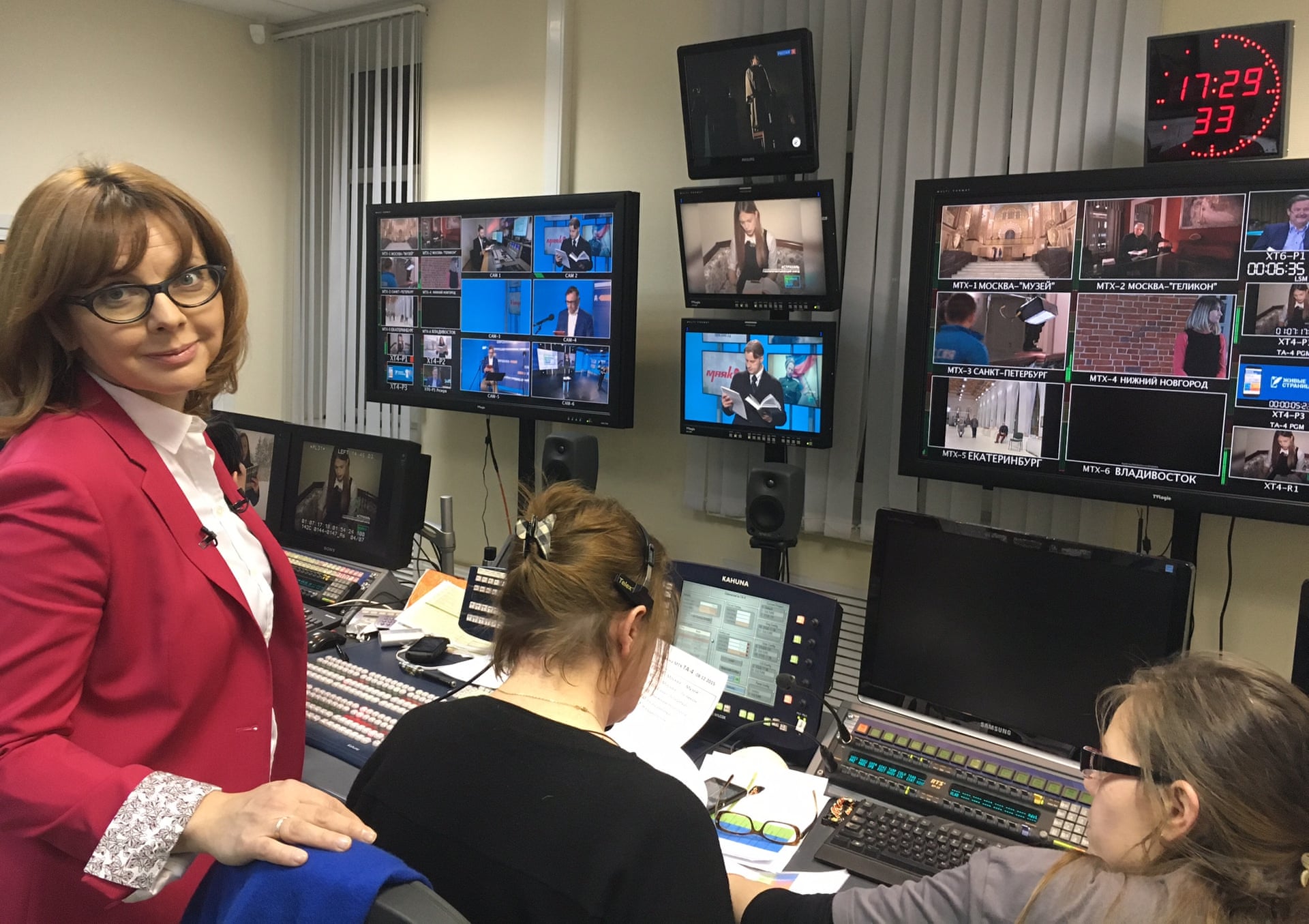
As well as the Oscar winner Wajda, the readers were drawn from across Russia, including schoolchildren, politicians, professors and actors – as well as one cosmonaut. More than 6,000 people applied to be part of the project, said Tolstaya, with the successful candidates each given a two-to-three minute excerpt from the novel, to be read in carefully chosen museums, libraries and institutions across Russia. French readers are also being drafted in to read the many sections of the novel written in French.
“This is the biggest reading of War and Peace in the world – a four-day marathon, uniting the whole country and people all over the world. [And] it is very democratic: we can have a minister of culture reading next to a student from Vladivostok, a great actor then an old lady reading from a library in Siberia,” Tolstaya said.
“For me it shows how we are all equal when we speak about literature, when we speak about books – everyone can find something for themselves in this book. Bearing in mind that my name is Tolstoy, I think you would allow me to say that War and Peace is the number one Russian book. And I say that not only because I am a Tolstoy, but because it is something special for every Russian. For me it is about love, about how the young grow up; and the older I become, the more philosophical I find this text.”
The reading marks the culmination Russia’s “year of literature”, and Tolstoys from around the world are also participating, Tolstaya said. “My family is very big – there are descendants of Tolstoy all over the world, so there will be Tolstoys reading from the US, Britain, Brazil and France.”
The Russian branch of the family will read from the Tolstoy family estate, Yasnaya Polyana, where he wrote War and Peace.
“For me it is extremely important to show the world that it is not only problems, and war and difficult things, happening in Russia, but that we can do something like this too,” Tolstaya said. “People argue with each other when they speak about politics, [but] culture, our cultural heritage, great Russian literature – this is the place where we all unite.”
As well as Wajda, other celebrities taking part include Andrei Konchalovsky, another director; Vladimir Urin, the Bolshoi ballet’s director, and Valentina Matvienko, speaker of the upper house of the Russian parliament.
source: http://www.theguardian.com/books/2015/dec/08/four-day-marathon-public-reading-of-war-and-peace-begins-in-russia
Coordinated by Tolstoy’s great-great-granddaughter Fekla Tolstaya, and featuring a number of cultural luminaries including the Polish film director Andrzej Wajda, the readings are being streamed by Russian state television channel Kultura. One volume of Tolstoy’s fictionalised history of Russia during the Napoleonic campaign will be read each day.
The novel opens in 1805, as Anna Pavlovna Scherer, “maid of honour and favourite of the Empress Marya Fedorovna”, is throwing a party with Napoleon being talked of as the man – and possible military adversary – of the hour. The mission to complete the reading of the novel’s more than half a million words is due to conclude by the end of Friday.
“We’re starting at 10am, and we will go through to midnight or two or three am, depending,” Tolstaya told the Guardian. “They’re extremely long.”
As well as the Oscar winner Wajda, the readers were drawn from across Russia, including schoolchildren, politicians, professors and actors – as well as one cosmonaut. More than 6,000 people applied to be part of the project, said Tolstaya, with the successful candidates each given a two-to-three minute excerpt from the novel, to be read in carefully chosen museums, libraries and institutions across Russia. French readers are also being drafted in to read the many sections of the novel written in French.
“This is the biggest reading of War and Peace in the world – a four-day marathon, uniting the whole country and people all over the world. [And] it is very democratic: we can have a minister of culture reading next to a student from Vladivostok, a great actor then an old lady reading from a library in Siberia,” Tolstaya said.
“For me it shows how we are all equal when we speak about literature, when we speak about books – everyone can find something for themselves in this book. Bearing in mind that my name is Tolstoy, I think you would allow me to say that War and Peace is the number one Russian book. And I say that not only because I am a Tolstoy, but because it is something special for every Russian. For me it is about love, about how the young grow up; and the older I become, the more philosophical I find this text.”
The reading marks the culmination Russia’s “year of literature”, and Tolstoys from around the world are also participating, Tolstaya said. “My family is very big – there are descendants of Tolstoy all over the world, so there will be Tolstoys reading from the US, Britain, Brazil and France.”
The Russian branch of the family will read from the Tolstoy family estate, Yasnaya Polyana, where he wrote War and Peace.
“For me it is extremely important to show the world that it is not only problems, and war and difficult things, happening in Russia, but that we can do something like this too,” Tolstaya said. “People argue with each other when they speak about politics, [but] culture, our cultural heritage, great Russian literature – this is the place where we all unite.”
As well as Wajda, other celebrities taking part include Andrei Konchalovsky, another director; Vladimir Urin, the Bolshoi ballet’s director, and Valentina Matvienko, speaker of the upper house of the Russian parliament.
source: http://www.theguardian.com/books/2015/dec/08/four-day-marathon-public-reading-of-war-and-peace-begins-in-russia

Why a pizza can’t fly
The story of a world-shaking innovative enterprise should start in a garage. The story of a flying pizza is no exception to this rule. One day in the spring of 2014, a police department in Syktyvkar, a city in Northwestern Russia, got a call from a concerned person who reported that a few suspicious young men occupied a garage in his neighborhood. They were making a lot of noise and were bothering all the respectable citizens living in the area.
When policemen arrived at the location, they did find a few people in the garage, although the crime scene looked somewhat unusual. The gang wasn’t smoking pot. There was no loud music. No half-naked girls. No parts of (probably stolen) cars could be seen. The space was instead filled with electronic equipment.
One of the men was Fedor Ovchinnikov, an entrepreneur and the founder of Dodo Pizza, a fast-growing Russian pizza chain established in Syktyvkar a few years ago. He was joined by Oleg Ponfilyonok, the founder of Copter Express, a startup company from Moscow.
The pizza guy and the сopter guy teamed up to find out how to make pizza deliveries by drones possible. The challenge was to do the real thing, for actual customers—not a performance for shooting a TV ad. Nobody had done something like this yet—not only in Syktyvkar or in Russia, but in the whole world.
The officer was evidently puzzled by what he saw. It was hard to articulate what exactly these people were doing that was against the law, since drones didn’t even exist when the law was written. He did his best to find the words to voice a complaint.
“People say that your thing is flying around at night making noise, and they can’t sleep,” he said.
“So, your recommendation for us is not to fly after eleven?” Ponfilyonok asked.
“My recommendation for you is to stop doing whatever you’re doing here,” the officer said.
Luckily (for the sake of our story of a flying pizza), they didn’t follow his recommendation. They didn’t stop.

Read all the article with pictures and videos at dodo's website
When policemen arrived at the location, they did find a few people in the garage, although the crime scene looked somewhat unusual. The gang wasn’t smoking pot. There was no loud music. No half-naked girls. No parts of (probably stolen) cars could be seen. The space was instead filled with electronic equipment.
One of the men was Fedor Ovchinnikov, an entrepreneur and the founder of Dodo Pizza, a fast-growing Russian pizza chain established in Syktyvkar a few years ago. He was joined by Oleg Ponfilyonok, the founder of Copter Express, a startup company from Moscow.
The pizza guy and the сopter guy teamed up to find out how to make pizza deliveries by drones possible. The challenge was to do the real thing, for actual customers—not a performance for shooting a TV ad. Nobody had done something like this yet—not only in Syktyvkar or in Russia, but in the whole world.
The officer was evidently puzzled by what he saw. It was hard to articulate what exactly these people were doing that was against the law, since drones didn’t even exist when the law was written. He did his best to find the words to voice a complaint.
“People say that your thing is flying around at night making noise, and they can’t sleep,” he said.
“So, your recommendation for us is not to fly after eleven?” Ponfilyonok asked.
“My recommendation for you is to stop doing whatever you’re doing here,” the officer said.
Luckily (for the sake of our story of a flying pizza), they didn’t follow his recommendation. They didn’t stop.

Read all the article with pictures and videos at dodo's website


Russian stereotypes of IT employees (with cute pictures)


Source: https://www.behance.net/gallery/31138923/IT-characters
Weird design: apartment block with "chicken legs"
This apartment block has 22 floors and 221 apartments. It's situated in St. Pete (see on Google maps). It was built in 1988.


More pictures of this remarkably grey building, including of apartments, you can find in this Russian article.


More pictures of this remarkably grey building, including of apartments, you can find in this Russian article.


Russian artist Katya Guschina sketches Transsib
She says:
I am really keen on two things: travelling and sketching. When i started my first yeat at university, i got an opportunity to combine my interests in one project - sketchbook about Transsib.
Transsib is nearly 9000 km long and it is one of the biggest railways in the world. Starting its way from Moscow, it goes through Udmurtia, Ural, Siberia, lake Baikal and Far East. This journey takes five days by train. For this project i used sources about the Transsib, blogs, books and personal memoirs of my friend and family. Follow the railway to see all the Russian beauty from the window of the train.
She sketches:


All of her sketches:


All of her sketches:
A Bright Future - New Works from Russia
Canadian architect turned photographer David Burdeny presents a collection of images showcasing the stunning and elaborate Moscow and St. Petersburg Metro system in A Bright Future - New Works from Russia.
The photographer spent two weeks shooting the aesthetically amazing stations and, as far as he's aware, remains the only photographer in the world to have been granted permission to shoot at these locations after they had been emptied of passengers.
It took over a year for the photographer to gain permission to pursue this project, and he was forced to rent the stations by the hour and shoot only after midnight.


This station is my favorite, sometimes I come there just to look at these glass columns and to touch them:

source: http://hyperallergic.com/242843/opulent-propaganda-the-subterranean-paradise-of-the-moscow-metro/
The photographer spent two weeks shooting the aesthetically amazing stations and, as far as he's aware, remains the only photographer in the world to have been granted permission to shoot at these locations after they had been emptied of passengers.
It took over a year for the photographer to gain permission to pursue this project, and he was forced to rent the stations by the hour and shoot only after midnight.


This station is my favorite, sometimes I come there just to look at these glass columns and to touch them:

source: http://hyperallergic.com/242843/opulent-propaganda-the-subterranean-paradise-of-the-moscow-metro/
What do Russians and Italians have in common?
Today I've found a nice post in my Facebook feed and ran here to share with you.
"It’s been nearly two months since I moved to Italy. And in these two months I’ve learned that Italians and Russians have much more in common than it could possibly make sense, both geographically and historically. The things I’m about to write are coming from a generalization of the worst kind - the one based on nationality, but I hope I manage to get through this minefield without offending anyone or falling into superficial labeling.
So. What do Russians and Italians have in common?
Sarcasm
This was a wonderful discovery that immediately made me feel at home. Italians are great at sarcasm and they use it in pretty much the same way Russians do. It’s not the English manner of: “Let me attempt to humiliate you as subtly as I possibly can, so that you don’t have any valid reason to punch me in the face”, it’s a violent, cheerful irony targeted at everyone and everything that happens to be in sight. Italians use sarcasm as a way of bonding, and the closer you become with someone, the harsher it gets. Tough love here.
Caring
If you look hungry - you will be fed. If you look upset - you won’t be left alone until you seem cheered up. If your house is invaded by aliens, there will be an uncle of a friend of a brother who once worked at disinfestation services and is ready to help: he is coming tomorrow at 7 a.m., stop arguing and get your protection suit ready. Caring is part of both the Russian and Italian DNA, and if someone likes you, he doesn’t need an invitation to start solving your problems. It’s a great thing when you need help and don’t know how to ask, but can be confusing if you are into figuring things out on your own.
Throwing money to the wind (for noble reasons)
Buying dinner for 10 people, half of whom you will never meet again? Check. Lending a third of your lifetime savings to a friend who happened to be in a terrible need of a new motorcycle? Check. Counting cents to the next salary? Check. Russians do it, Italians do it better. I thought I was used to the generosity that almost borders on a proud detestation of having money, but even I had to adjust my meter to the Italian scale.
Expensive taste
Speaking of wasting money. Moscow and Milan are surely the two capitals of designer bags. One time I decided to count all the purses that cost over a thousand euros while going home by tram. Fourteen. And there could not have been more than twenty women on the tram. I bet half of those bags are good fakes, indistinguishable from the originals until you start examining them closely, but still - it means that 1/3 of all women on the tram own a real designer bag.
Loving your country, but not liking it
This is a dangerous topic, but it seems that both Italians and Russians are used to keeping detailed lists of everything that’s wrong with their motherland. People here can talk about the beauty of Italy for hours – they are proud of it in the same way one is proud of his local football team – but many of those with whom I shared more than one bottle of wine have plans of leaving Italy at some point.
Inventiveness
Outsmarting the system for the pure joy of it is a national sport both for Italians and Russians. If there’s any rule worth breaking - it will be broken, graciously.
Love of tragedy
If you’re going to be stuck with a project late at night, make sure all the seven floors of your office know how bad it all is, how desperate you are, how deep the boss will bury your corpse if you fail to deliver. And then, when you happen to sell that line: “Buy one - get one free”, you can celebrate gloriously, because you’ve just prevented the biggest catastrophe on Earth. I’m exaggerating shamelessly, of course, but, oh, it feels like home.
Low boiling point
If an Italian is unhappy about something - you will know it; if he is delighted - you will quickly be informed. Same goes for Russians. No poker faces needed – you won’t get confused deciphering the mood of those around you. They will throw it all in your face long before you've even detected anything was wrong, and it might as well break your nose.
Passion
The wild prowess that, without a proper object, brings chaos and starts fights. You will see this glimpse of happy anger in the eyes of a Russian, as he drives his car 150 km/h into a snowstorm. You will find the same in the eyes of an Italian - even as he parks his Vespa in a quiet street. It takes one to know one".
Source: https://www.facebook.com/polina.zabrodskaya/posts/10204779617802128
"It’s been nearly two months since I moved to Italy. And in these two months I’ve learned that Italians and Russians have much more in common than it could possibly make sense, both geographically and historically. The things I’m about to write are coming from a generalization of the worst kind - the one based on nationality, but I hope I manage to get through this minefield without offending anyone or falling into superficial labeling.
So. What do Russians and Italians have in common?
Sarcasm
This was a wonderful discovery that immediately made me feel at home. Italians are great at sarcasm and they use it in pretty much the same way Russians do. It’s not the English manner of: “Let me attempt to humiliate you as subtly as I possibly can, so that you don’t have any valid reason to punch me in the face”, it’s a violent, cheerful irony targeted at everyone and everything that happens to be in sight. Italians use sarcasm as a way of bonding, and the closer you become with someone, the harsher it gets. Tough love here.
Caring
If you look hungry - you will be fed. If you look upset - you won’t be left alone until you seem cheered up. If your house is invaded by aliens, there will be an uncle of a friend of a brother who once worked at disinfestation services and is ready to help: he is coming tomorrow at 7 a.m., stop arguing and get your protection suit ready. Caring is part of both the Russian and Italian DNA, and if someone likes you, he doesn’t need an invitation to start solving your problems. It’s a great thing when you need help and don’t know how to ask, but can be confusing if you are into figuring things out on your own.
Throwing money to the wind (for noble reasons)
Buying dinner for 10 people, half of whom you will never meet again? Check. Lending a third of your lifetime savings to a friend who happened to be in a terrible need of a new motorcycle? Check. Counting cents to the next salary? Check. Russians do it, Italians do it better. I thought I was used to the generosity that almost borders on a proud detestation of having money, but even I had to adjust my meter to the Italian scale.
Expensive taste
Speaking of wasting money. Moscow and Milan are surely the two capitals of designer bags. One time I decided to count all the purses that cost over a thousand euros while going home by tram. Fourteen. And there could not have been more than twenty women on the tram. I bet half of those bags are good fakes, indistinguishable from the originals until you start examining them closely, but still - it means that 1/3 of all women on the tram own a real designer bag.
Loving your country, but not liking it
This is a dangerous topic, but it seems that both Italians and Russians are used to keeping detailed lists of everything that’s wrong with their motherland. People here can talk about the beauty of Italy for hours – they are proud of it in the same way one is proud of his local football team – but many of those with whom I shared more than one bottle of wine have plans of leaving Italy at some point.
Inventiveness
Outsmarting the system for the pure joy of it is a national sport both for Italians and Russians. If there’s any rule worth breaking - it will be broken, graciously.
Love of tragedy
If you’re going to be stuck with a project late at night, make sure all the seven floors of your office know how bad it all is, how desperate you are, how deep the boss will bury your corpse if you fail to deliver. And then, when you happen to sell that line: “Buy one - get one free”, you can celebrate gloriously, because you’ve just prevented the biggest catastrophe on Earth. I’m exaggerating shamelessly, of course, but, oh, it feels like home.
Low boiling point
If an Italian is unhappy about something - you will know it; if he is delighted - you will quickly be informed. Same goes for Russians. No poker faces needed – you won’t get confused deciphering the mood of those around you. They will throw it all in your face long before you've even detected anything was wrong, and it might as well break your nose.
Passion
The wild prowess that, without a proper object, brings chaos and starts fights. You will see this glimpse of happy anger in the eyes of a Russian, as he drives his car 150 km/h into a snowstorm. You will find the same in the eyes of an Italian - even as he parks his Vespa in a quiet street. It takes one to know one".
Source: https://www.facebook.com/polina.zabrodskaya/posts/10204779617802128

Working in Russia: Finnish investor shares his impressions
If you’re working in international business, you have most likely participated in some kind of diversity or cultural training sessions. You know the kind. Those meetings where we learn that Germans are punctual, Italians are emotional and Finns don’t talk — without some alcohol.
For me, the past 1,000 days of working in Russia have been a true deep dive into the Russian landscape, business culture and mentality. And I have gained an understanding that is impossible to get from these sterilized meetings, which tend to focus on stereotypes.
During this amazing journey, I have visited 59 Russian cities, embraced numerous governors and seen all 11 time zones of this enormous country. And it is worth mentioning that all my preconceived notions about Russia were wrong.
Before deciding to come to work in Russia, I had very little knowledge of it, even though my own country — Finland — shares a long border with it. I had been a tourist in Moscow and St. Petersburg, but as the Finnish and Russian languages share probably only three common words, my ability to communicate and get to know people was very limited.
So what are my observations so far?
I’m a nerd, so I was thrilled to see the level and quality of telecommunications across the country — in complete contrast to my wildest expectations. Russians truly love and use all the latest gadgets. The post-Soviet “PlayStation Generation” is particularly well connected. Social media is widely used, and news from all over the world is at everyone’s fingertips. There is no “Great Firewall,” on the Russian Internet, like in China, so it is very annoying to see even serious, informed people lump Russia and China together in the same category when discussing online freedom.
Despite all my doubts, the infrastructure of the cities I have visited more or less meets European and American standards. Yes, some of the roads are pretty bad, but airports, hotels, restaurants and other services are well developed. Starbucks is everywhere, and I use my credit card for almost everything. I pay my bills using the online services of Russian banks, and money transfers from my home bank can be arranged overnight. For travel I use mostly airlines like Aeroflot, which has a very modern fleet of Airbus planes. I am not a specialist in air travel by any means, but as an anecdote I must say that in the past 1,000 days, I have only had my flights delayed twice, and for 15 minutes at the most.
Of course the state of the Russian economy right now is not good, but this current turbulence is good for my business — promoting the culture of startups and innovation in Russia. If oil prices were high, it would be practically impossible to convince any local businesses to make difficult restructuring decisions.
Naturally, I don’t wish hard times on anyone, but now, when I see the creation of new businesses and the modernization of big companies, I can’t help but think that there are some benefits to the current situation.
Also from the standpoint of an investor, the devalued currency has created many opportunities — after all, our potential to make money occurs in the “buying” stage of the investment.
But I must mention the most beautiful part of life in Russia — the food. When I arrived in the country, the only Russian food I knew of was borscht. But in the first few days, I realized that Russians will spend a lot of money on two things — high-quality food and high-heeled shoes. In every city I visit, I just have to log on to TripAdvisor to see an amazing variety of restaurants and cuisine.
There is something for every taste — from sushi to Caucasian cuisine.
So, dear friends in the global business community, open your eyes to Russia. Take it from me — seeing is believing!
Source
For me, the past 1,000 days of working in Russia have been a true deep dive into the Russian landscape, business culture and mentality. And I have gained an understanding that is impossible to get from these sterilized meetings, which tend to focus on stereotypes.
During this amazing journey, I have visited 59 Russian cities, embraced numerous governors and seen all 11 time zones of this enormous country. And it is worth mentioning that all my preconceived notions about Russia were wrong.
Before deciding to come to work in Russia, I had very little knowledge of it, even though my own country — Finland — shares a long border with it. I had been a tourist in Moscow and St. Petersburg, but as the Finnish and Russian languages share probably only three common words, my ability to communicate and get to know people was very limited.
So what are my observations so far?
I’m a nerd, so I was thrilled to see the level and quality of telecommunications across the country — in complete contrast to my wildest expectations. Russians truly love and use all the latest gadgets. The post-Soviet “PlayStation Generation” is particularly well connected. Social media is widely used, and news from all over the world is at everyone’s fingertips. There is no “Great Firewall,” on the Russian Internet, like in China, so it is very annoying to see even serious, informed people lump Russia and China together in the same category when discussing online freedom.
Despite all my doubts, the infrastructure of the cities I have visited more or less meets European and American standards. Yes, some of the roads are pretty bad, but airports, hotels, restaurants and other services are well developed. Starbucks is everywhere, and I use my credit card for almost everything. I pay my bills using the online services of Russian banks, and money transfers from my home bank can be arranged overnight. For travel I use mostly airlines like Aeroflot, which has a very modern fleet of Airbus planes. I am not a specialist in air travel by any means, but as an anecdote I must say that in the past 1,000 days, I have only had my flights delayed twice, and for 15 minutes at the most.
Of course the state of the Russian economy right now is not good, but this current turbulence is good for my business — promoting the culture of startups and innovation in Russia. If oil prices were high, it would be practically impossible to convince any local businesses to make difficult restructuring decisions.
Naturally, I don’t wish hard times on anyone, but now, when I see the creation of new businesses and the modernization of big companies, I can’t help but think that there are some benefits to the current situation.
Also from the standpoint of an investor, the devalued currency has created many opportunities — after all, our potential to make money occurs in the “buying” stage of the investment.
But I must mention the most beautiful part of life in Russia — the food. When I arrived in the country, the only Russian food I knew of was borscht. But in the first few days, I realized that Russians will spend a lot of money on two things — high-quality food and high-heeled shoes. In every city I visit, I just have to log on to TripAdvisor to see an amazing variety of restaurants and cuisine.
There is something for every taste — from sushi to Caucasian cuisine.
So, dear friends in the global business community, open your eyes to Russia. Take it from me — seeing is believing!
Source
Anton Chekhov
As I re-read Chekhov's stories myself, I would love to share them with you. They are witty, clever, heartwarming and truthful. And short.
I found this website with several of them but I guess there are hundreds of possibilities. Chekhov was translated a long time ago and many people adore his work.

I found this website with several of them but I guess there are hundreds of possibilities. Chekhov was translated a long time ago and many people adore his work.
Subway employees, St. Petersburg
Soon there will be photo exhibition full of official subway peeps' shots. A couple of photographers worked for 6 months taking pictures of underground workers.
Just look at them:

Just look at them:


Sixty-five-year-old Russian clown Slava Polunin
I've seen Slava Polunin's Snow show ads in Portugal and Spain this summer. Europe will embrace Russian clown several times, as seen in his schedule. So I've decided to tell you about him.

Sixty-five-year-old Russian clown, Slava Polunin began his incredible career over four decades ago. According to CNN, what started out as a fascination developed into a probable career path for Polunin after he watched Charlie Chaplin in The Kid. A child at the time, he went to school in his father’s hat, boots and cane – emulating Chaplin, he made the other kids laugh all day.
Polunin became very fascinated with the way movement could convey so much emotion. He studied dances from around the world and he would imitate everything from Disney characters to kids, insane people, drunks, and animals stating, “these movements are not limited by intellect.” Polunin described his inspirations in an interview with CNN: “The perfect example is to see a child playing on a playground, or running around a forest — this is how humankind used to be originally – genuine and excited. These movements evoke a desire to follow.”
Polunin’s career has been filled with many highs including performing on state television throughout the 1970s and 1980s. It was there that he would mock authorities – making parodies out of communist restrictions – and get away with it. Because no actual words were being used, Polunin could convey important messages without actually saying them. Later in his career he created the “Academy of Fools,” an international organization uniting clowns, and “Caravan of the World,” a travelling theatre. Today, Polunin is one of the most notable clowns in the business – performing in 50 countries across the world.
But Polunin is not your average over-the-top circus clown. He puts a lot of thought into all of his actions, stating to CNN: “Today my perception of clowning is that you should be able to move just one centimeter and get a reaction from the audience as if you moved an entire mountain.” He also changes his routines based on the different countries he visits, noting that each culture has a different sense of movement and humour.
In all areas of his life, Polunin keeps the creativity and fun alive. According to Messy Nessy Chic, he even hosts visitors at his Dali-meets-Disney wonderland. And the list of oddities – including five kaleidoscopic gardens, book trees, walls you can walk through, flower beds you can sleep in, staircases that melt into the walls, giants living in trees, a giant egg house, horses with pink wings, and a Buddhist temple – is enough to make your head spin.
Polunin is going to be featured in an upcoming documentary, “Secrets of Snow – Slava’s Journey,” which will surely be a majestic and hypnotically visual ride.

What Is My Kind of Theatre?
or
The Theatre I Love
- It is a kind of wedding cavalcade,
where I try to marry everyone to everyone;
- It is a theatre of ritual magic
and festive pageantry,
constructed on the basis of images and movements,
games and fantasies,
that are the common creation of the audience and the people of the theatre;
- It is a theatre which inexorably grows
from dreams and tales;
- It is a theatre of hopes and dreams,
full of longing and loneliness,
losses and disillusionment;
- It is a theatre which always changes,
which breaths spontaneous improvisation
and cares scrupulously for tradition;
- It is in the vein of contemporary
multi-layered synthesis,
on the boundary of life and art;
- It is a theatre that works in an epic-intimate alloy
of tragedy and comedy,
of absurdity and naivity,
of cruelty and gentleness;
- It is a theatre which escapes
definition and the unequivocal
understanding of its actions,
as from attempts to usurp its freedom.
Slava Polunin
Sixty-five-year-old Russian clown, Slava Polunin began his incredible career over four decades ago. According to CNN, what started out as a fascination developed into a probable career path for Polunin after he watched Charlie Chaplin in The Kid. A child at the time, he went to school in his father’s hat, boots and cane – emulating Chaplin, he made the other kids laugh all day.
Polunin became very fascinated with the way movement could convey so much emotion. He studied dances from around the world and he would imitate everything from Disney characters to kids, insane people, drunks, and animals stating, “these movements are not limited by intellect.” Polunin described his inspirations in an interview with CNN: “The perfect example is to see a child playing on a playground, or running around a forest — this is how humankind used to be originally – genuine and excited. These movements evoke a desire to follow.”
Polunin’s career has been filled with many highs including performing on state television throughout the 1970s and 1980s. It was there that he would mock authorities – making parodies out of communist restrictions – and get away with it. Because no actual words were being used, Polunin could convey important messages without actually saying them. Later in his career he created the “Academy of Fools,” an international organization uniting clowns, and “Caravan of the World,” a travelling theatre. Today, Polunin is one of the most notable clowns in the business – performing in 50 countries across the world.
But Polunin is not your average over-the-top circus clown. He puts a lot of thought into all of his actions, stating to CNN: “Today my perception of clowning is that you should be able to move just one centimeter and get a reaction from the audience as if you moved an entire mountain.” He also changes his routines based on the different countries he visits, noting that each culture has a different sense of movement and humour.
In all areas of his life, Polunin keeps the creativity and fun alive. According to Messy Nessy Chic, he even hosts visitors at his Dali-meets-Disney wonderland. And the list of oddities – including five kaleidoscopic gardens, book trees, walls you can walk through, flower beds you can sleep in, staircases that melt into the walls, giants living in trees, a giant egg house, horses with pink wings, and a Buddhist temple – is enough to make your head spin.
Polunin is going to be featured in an upcoming documentary, “Secrets of Snow – Slava’s Journey,” which will surely be a majestic and hypnotically visual ride.
How St Petersburg is creating a permanent home for street art
The world of street art abounds with irony. Supporters of this art form (which is largely predicated on defacing other people’s property) have protested plans to demolish the graffiti-covered 5 Pointz building in Queens, New York. The “outlaw” Banksy is a savvy self-promoter whose new Dismaland project, in the English seaside town of Weston-super-Mare, has been described as “the most shameless commercial art project since Disneyland”.
So perhaps we shouldn’t be surprised that this outsider art form now has its own official cultural venue in the Street Art Museum in St Petersburg, Russia. If such an institution seems a contradiction in terms for an art form that, by definition, is supposed to take place on the street, curator Nailya Allahverdiyeva seems to be its biggest opponent. “In general, I hate street art expositions, because I consider that to be a profanation of street art,” she told the Moscow Times. “I have done everything I can to drive artists out on to the street.”
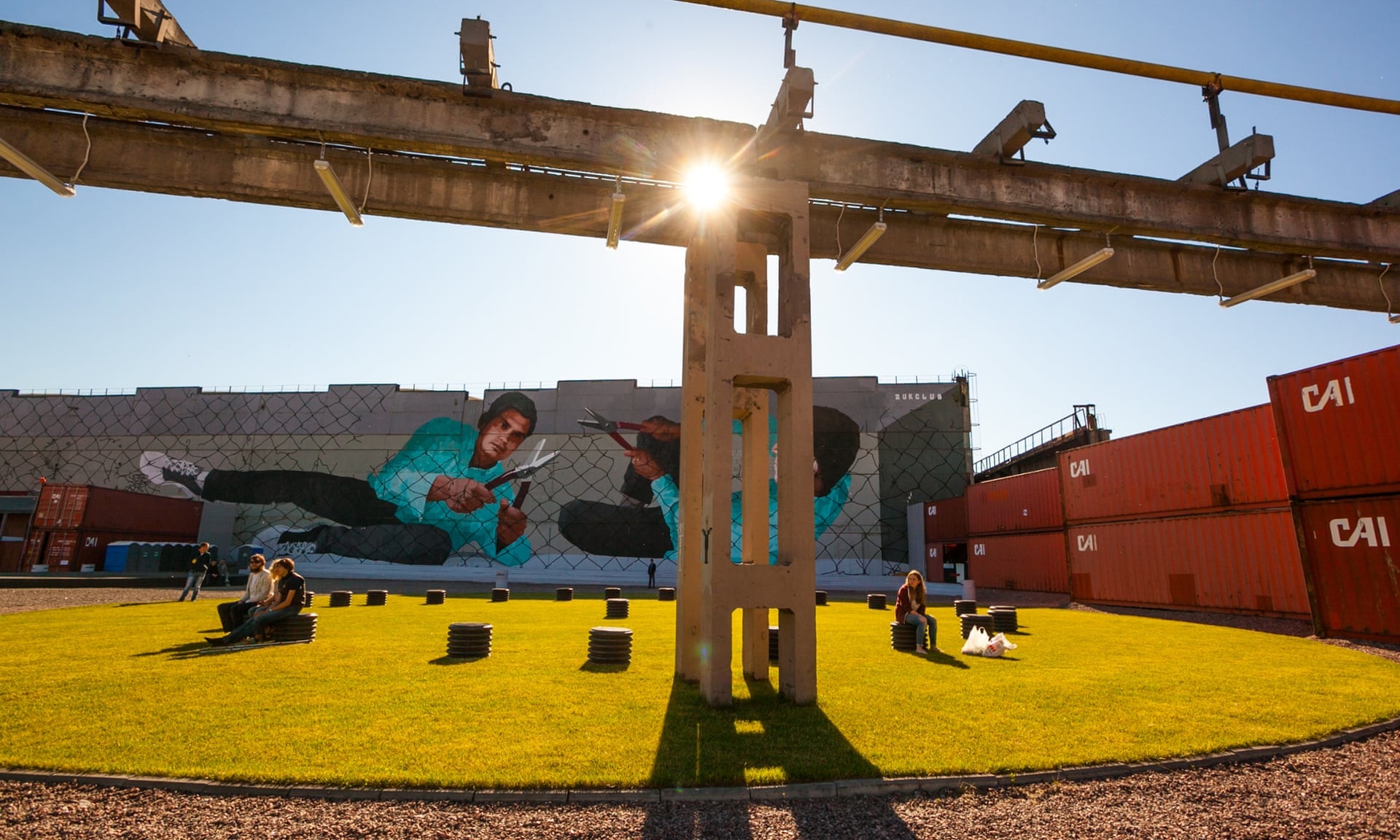
And yet, Allahverdiyeva is one of the co-curators of this year’s exhibition at the Street Art Museum. “The idea that a street art museum couldn’t exist is very popular among the people,” says Albina Motor, the museum’s producer. “But we are not a museum in the conventional sense. It’s just a name for much more.”
Most visitors looking for art in St Petersburg will check out the Hermitage or the Mariinsky theatre. The Street Art Museum is certainly not yet on the agenda – nor, as Motor says, is it a typical museum. For one thing, it’s located inside an active factory, the Sloplast plastics laminate works, in an industrial zone far outside the city’s central tourist core.
A working factory is, of course, a perfect setting for a street art museum, as factories are a typical “canvas” for street art performances. But beyond the art itself, the museum is seeking to create a cultural identity in a district that’s currently mentally, as well as physically, a world away from the city’s historic core. St Petersburg was founded by Peter the Great in 1703 as a “European-style” capital, with architecture that exudes the refined charm of western European cities. It is also endowed with a legacy of renowned cultural institutions, which help make it the most-visited Russian city for foreign tourists.
But the tourist zone in the city centre is fairly small. St Petersburg was also developed into a huge industrial centre: it is ringed with miles of factories, many of them now closed. As with many post-industrial cities, “Piter,” as Russians call it, needs to reinvent itself for a new era.
So how do you refresh an industrial district in the middle ring of this classical city? With street art, of course. The Street Art Museum engages with both functioning industry and the world of art – for which the city is already well-known. Even the museum’s logo – a spray can styled as a classic architectural column – playfully draws on the city’s high-culture reputation. But this a different kind of art for a different kind of district, one that is drawing tourists and international attention to the kind of urban zone that seldom sees much of either.
Whereas the more well-known institutions in St Petersburg are oriented towards the past, the Street Art Museum is engaging with the present – not just in terms of street art, but also contemporary issues facing Russians. Vladimir Putin’s authoritarian turn has lent a degree of seriousness and importance to Russian street art that transcends the mere posturing and thinly veiled commercialism too often present in the west. Examples range from the anti-Putin works of the late P183 to the street performance of art-collective Voina.
It was the factory owner himself, Dmitry Zaitsev, who created the museum, and his son Andrey is the museum’s director. Because it’s in a factory, a good deal of the “permanent collection” comprises murals overlooking active factory floors full of workers, such as God at Work by Roman Kreemos or Supreme (in homage to suprematism) by Petro.
“The original idea was to make this place cosy for working,” says Motor, highlighting the industrial logic behind these works, which are normally off-limits to museum-goers and require special advance arrangements to see. The relationship between factory and museum goes the other way, too: the chairs in the museum cafe were made from the factory’s products and assembled by its workers.
But is street art something the workers actually like, or just something the creative class thinks they should like? Motor recalls a conversation between two workers about street artist Kirill Kto’s artwork Sometimes Yes, Sometimes No: “Sometimes yes, sometimes bullshit” – a sentiment to which anyone who’s ever been to a museum can probably relate.
A massive outdoor area and decommissioned parts of the factory, like the boiler house, are used for temporary exhibits, such as The Cage by Zuk Club, Toy Group’s humorous “flyers”, or an enormous wall-sized manifesto called Everything I Know About Street Art by Timothy Radya.
The venue also provides street artists with the opportunity to work experimentally in forms they have never used before, and the space to create work that won’t immediately be disregarded as disposable. For example, Andrey Olenev exhibits a series of charred logs that encircle a room. The charred smell is still present, lending an extra dimension to this piece – and, as with many of the best works of contemporary art, it has an ambiguity that captures your attention: it is not immediately obvious whether it is art or debris, or indeed exactly which parts of the room are art, which are “gallery” and which are factory. You can’t simply drift past these exhibitions like so many paintings on a wall.
Could the idea catch on? A group in New York called the Street Museum of Art tours exhibits on the street, while Amsterdam’s Street Art Museum is a walking tour. The V&A in London has a street art collection, and there are plans afoot for something similar in New Jersey; but, in general, the paradoxical nature of the idea helps explain why the Street Art Museum is the first of its kind.
Meanwhile, as with all street art, it’s an idea that is constantly changing, as the gallery mixes up the collection, and the fortunes of the factory itself fluctuate. “Some people think that museums are kind of cemeteries for art,” Motor says. “We have no intention of becoming a graveyard for street art.”
(from The Guardian)
So perhaps we shouldn’t be surprised that this outsider art form now has its own official cultural venue in the Street Art Museum in St Petersburg, Russia. If such an institution seems a contradiction in terms for an art form that, by definition, is supposed to take place on the street, curator Nailya Allahverdiyeva seems to be its biggest opponent. “In general, I hate street art expositions, because I consider that to be a profanation of street art,” she told the Moscow Times. “I have done everything I can to drive artists out on to the street.”
And yet, Allahverdiyeva is one of the co-curators of this year’s exhibition at the Street Art Museum. “The idea that a street art museum couldn’t exist is very popular among the people,” says Albina Motor, the museum’s producer. “But we are not a museum in the conventional sense. It’s just a name for much more.”
Most visitors looking for art in St Petersburg will check out the Hermitage or the Mariinsky theatre. The Street Art Museum is certainly not yet on the agenda – nor, as Motor says, is it a typical museum. For one thing, it’s located inside an active factory, the Sloplast plastics laminate works, in an industrial zone far outside the city’s central tourist core.
A working factory is, of course, a perfect setting for a street art museum, as factories are a typical “canvas” for street art performances. But beyond the art itself, the museum is seeking to create a cultural identity in a district that’s currently mentally, as well as physically, a world away from the city’s historic core. St Petersburg was founded by Peter the Great in 1703 as a “European-style” capital, with architecture that exudes the refined charm of western European cities. It is also endowed with a legacy of renowned cultural institutions, which help make it the most-visited Russian city for foreign tourists.
But the tourist zone in the city centre is fairly small. St Petersburg was also developed into a huge industrial centre: it is ringed with miles of factories, many of them now closed. As with many post-industrial cities, “Piter,” as Russians call it, needs to reinvent itself for a new era.
So how do you refresh an industrial district in the middle ring of this classical city? With street art, of course. The Street Art Museum engages with both functioning industry and the world of art – for which the city is already well-known. Even the museum’s logo – a spray can styled as a classic architectural column – playfully draws on the city’s high-culture reputation. But this a different kind of art for a different kind of district, one that is drawing tourists and international attention to the kind of urban zone that seldom sees much of either.
Whereas the more well-known institutions in St Petersburg are oriented towards the past, the Street Art Museum is engaging with the present – not just in terms of street art, but also contemporary issues facing Russians. Vladimir Putin’s authoritarian turn has lent a degree of seriousness and importance to Russian street art that transcends the mere posturing and thinly veiled commercialism too often present in the west. Examples range from the anti-Putin works of the late P183 to the street performance of art-collective Voina.
It was the factory owner himself, Dmitry Zaitsev, who created the museum, and his son Andrey is the museum’s director. Because it’s in a factory, a good deal of the “permanent collection” comprises murals overlooking active factory floors full of workers, such as God at Work by Roman Kreemos or Supreme (in homage to suprematism) by Petro.
“The original idea was to make this place cosy for working,” says Motor, highlighting the industrial logic behind these works, which are normally off-limits to museum-goers and require special advance arrangements to see. The relationship between factory and museum goes the other way, too: the chairs in the museum cafe were made from the factory’s products and assembled by its workers.
But is street art something the workers actually like, or just something the creative class thinks they should like? Motor recalls a conversation between two workers about street artist Kirill Kto’s artwork Sometimes Yes, Sometimes No: “Sometimes yes, sometimes bullshit” – a sentiment to which anyone who’s ever been to a museum can probably relate.
A massive outdoor area and decommissioned parts of the factory, like the boiler house, are used for temporary exhibits, such as The Cage by Zuk Club, Toy Group’s humorous “flyers”, or an enormous wall-sized manifesto called Everything I Know About Street Art by Timothy Radya.
The venue also provides street artists with the opportunity to work experimentally in forms they have never used before, and the space to create work that won’t immediately be disregarded as disposable. For example, Andrey Olenev exhibits a series of charred logs that encircle a room. The charred smell is still present, lending an extra dimension to this piece – and, as with many of the best works of contemporary art, it has an ambiguity that captures your attention: it is not immediately obvious whether it is art or debris, or indeed exactly which parts of the room are art, which are “gallery” and which are factory. You can’t simply drift past these exhibitions like so many paintings on a wall.
Could the idea catch on? A group in New York called the Street Museum of Art tours exhibits on the street, while Amsterdam’s Street Art Museum is a walking tour. The V&A in London has a street art collection, and there are plans afoot for something similar in New Jersey; but, in general, the paradoxical nature of the idea helps explain why the Street Art Museum is the first of its kind.
Meanwhile, as with all street art, it’s an idea that is constantly changing, as the gallery mixes up the collection, and the fortunes of the factory itself fluctuate. “Some people think that museums are kind of cemeteries for art,” Motor says. “We have no intention of becoming a graveyard for street art.”
(from The Guardian)
Subscribe to:
Posts (Atom)